
The Krantula Khan Chakardar Tihai in Teen Taal: Exploring the Magic of 16 Beats
Introduction: The Beauty of Tabla Rhythm
The tabla is one of the most expressive percussion instruments in Indian classical music, celebrated for its intricate rhythms, dynamic sounds, and extraordinary mathematical precision. Among the many exciting rhythmic compositions performed by tabla players, the Chakardar Tihai in Teen Taal holds a special place because it combines rhythmic complexity, repetition, and a dramatic resolution on the sam, the first beat of the rhythmic cycle.
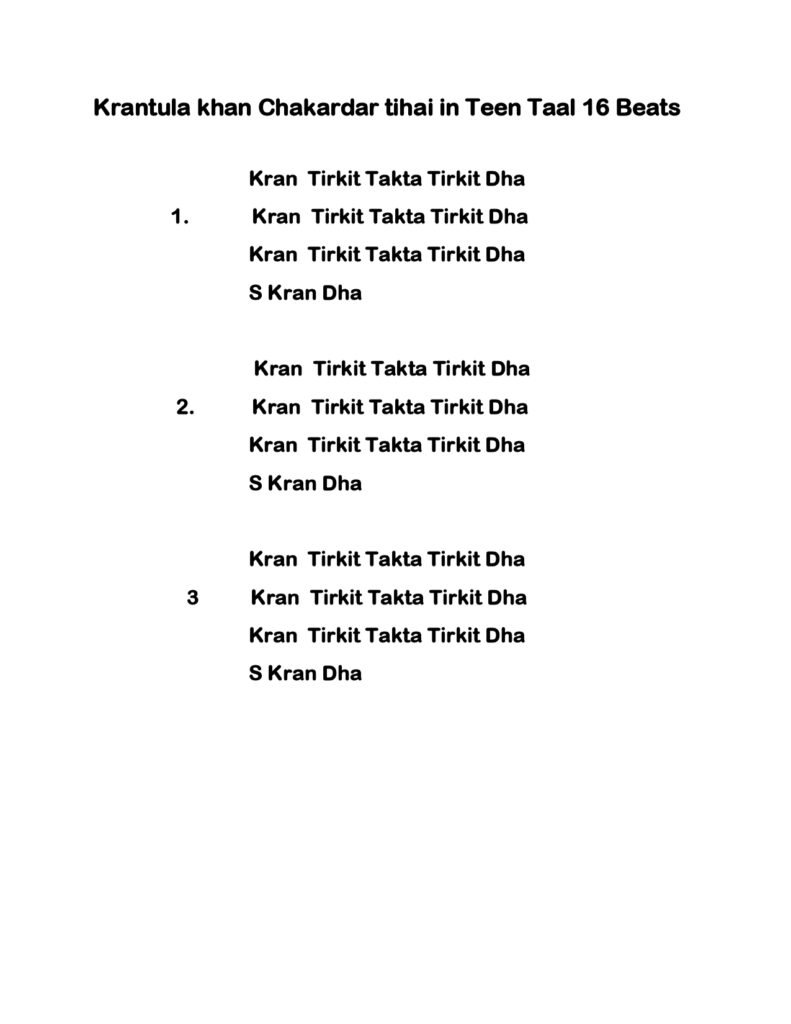
The Krantula Khan Chakardar Tihai is an interesting subject for tabla enthusiasts, students, and performers who want to explore the relationship between traditional rhythmic composition and mathematical structure. Set within Teen Taal, a cycle of 16 beats, this type of composition challenges a performer to maintain clarity, accuracy, and musical expression while building toward a powerful rhythmic conclusion.
Understanding Teen Taal: The Foundation of the Composition
Teen Taal, also known as Tintal, is one of the most widely used taals in Hindustani classical music. It consists of 16 matras, divided into four equal sections of four beats each.
Its basic structure is:
Dha Dhin Dhin Dha | Dha Dhin Dhin Dha | Na Tin Tin Na | Ta Dhin Dhin Dha
The first beat is called sam, the second section begins with a clap on beat five, and the third section begins with a wave, or khali, on beat nine. The fourth section begins with a clap on beat thirteen.
The traditional hand gestures are:
- Beat 1: Clap — Sam
- Beat 5: Clap
- Beat 9: Wave — Khali
- Beat 13: Clap
These divisions make Teen Taal an excellent framework for learning complex compositions, including peshkar, kayda, rela, tukra, and chakardar tihai.
What Is a Chakardar Tihai?
To understand the Krantula Khan Chakardar Tihai, it helps to examine the meaning of its two principal rhythmic terms.
A tihai is a rhythmic phrase repeated three times, usually with the intention of arriving on the sam. The repeated phrase creates anticipation, and the final landing provides a satisfying musical resolution.
A chakardar is a composition in which a phrase, often containing a tihai, is presented in a larger repeated structure. In common performance practice, the complete composition is played three times, with the final stroke or phrase resolving on the sam. The exact internal structure can vary by tradition and composition.
The Krantula Khan Chakardar Tihai should therefore be approached as a specific rhythmic composition rather than simply as any threefold repetition. Its precise bols, spacing, and starting position determine how it fits into the 16-beat cycle.
Exploring the Rhythmic Mathematics
One of the most fascinating aspects of a chakardar tihai is its mathematical organization. The performer must calculate the duration of the phrase, the gaps between repetitions if present, and the starting point required for the final stroke to meet the sam.
For a simple illustration, imagine a phrase lasting four matras, repeated three times without any intervening gaps. The total duration is:
4 + 4 + 4 = 12 matras
If the phrase begins on beat five, the final stroke can be positioned to arrive at beat sixteen, depending on how the phrase’s strokes are counted. The next beat is the sam of the following cycle.
Real chakardar compositions can be considerably more complicated. They may include subdivisions, rests, syncopation, and internal tihai structures. The bols must be counted according to their actual rhythmic duration rather than merely by counting syllables.
This mathematical precision is what makes the composition both challenging and rewarding.
How to Practise the Krantula Khan Chakardar Tihai
For students learning this composition, a systematic approach is essential.
Step 1: Establish the theka. Play the basic Teen Taal theka slowly and maintain a steady 16-beat cycle.
Step 2: Learn the bols. Memorize the composition through recitation before attempting to play it. Speaking the bols helps develop rhythmic awareness and improves accuracy.
Step 3: Count the subdivisions. Identify where the phrase begins, where each repetition starts, and where the final stroke lands. Use a metronome or lehra to maintain a consistent tempo.
Step 4: Practise slowly. Begin at a comfortable speed and increase the tempo only when the composition remains clear and controlled.
Step 5: Resolve on sam. Focus on the final arrival. A well-executed chakardar tihai should sound deliberate and convincing, not rushed.
An important point is that the exact bols of the Krantula Khan composition should be taken from a reliable notation, recording, or oral teaching source. Without a verified version, inventing the bols could produce a different composition.
Musical Expression and Performance
Although mathematical accuracy is important, tabla playing is not only an exercise in calculation. The quality of the sound, the contrast between the dayan and bayan, and the clarity of each syllable all contribute to the musical effect.
A skilled performer balances precision with expression. The first repetition establishes the pattern, the second strengthens the listener’s expectation, and the third creates anticipation for the arrival on sam.
When performed in a solo recital, a chakardar tihai can serve as a striking conclusion to a rhythmic development. In an accompaniment setting, it can also create a memorable moment when coordinated with the melodic instrument and the rhythmic cycle.
Conclusion: Tradition, Mathematics, and Creativity
The Krantula Khan Chakardar Tihai in Teen Taal illustrates the remarkable connection between mathematics and musical artistry in tabla. Through repetition, rhythmic calculation, and a carefully planned arrival on sam, the composition demonstrates how a 16-beat cycle can support intricate and exciting rhythmic ideas.
For tabla students, learning such a composition develops concentration, rhythmic memory, and an understanding of traditional performance structure. For listeners, it reveals the beauty of Indian classical rhythm and the excitement of a perfectly timed musical resolution.
Have you heard the Krantula Khan Chakardar Tihai performed live? Share your experience, discuss the version you are learning, and explore how different tabla maestros bring their own clarity, energy, and expression to Teen Taal.
Note for accuracy: The exact bol sequence of the Krantula Khan Chakardar Tihai has not been verified here. If you share the bols or a recording of the version you mean, I can revise the blog to include its precise notation, beat-by-beat counting, and correct sam calculation.
https://www.youtube.com/@BhagawanSingh
https://www.facebook.com/sbsinghtablaguru