
Master Jhaptaal: 10 Mukhda, Mohra & Bedam Tihai Guide
Introduction
Here’s a fun fact: Jhaptaal, with its 10 beats, is one of the most intellectually satisfying rhythmic cycles in Hindustani music—it constantly keeps both the performer and listener slightly off balance in the best way possible. Unlike more symmetrical taals like Teentaal (16 beats), Jhaptaal’s uneven structure invites creativity, surprise, and precision. If you want to deepen your tabla vocabulary, mastering mukhda, mohra, and bedam tihai in Jhaptaal is a powerful step forward.
Understanding Jhaptaal Structure
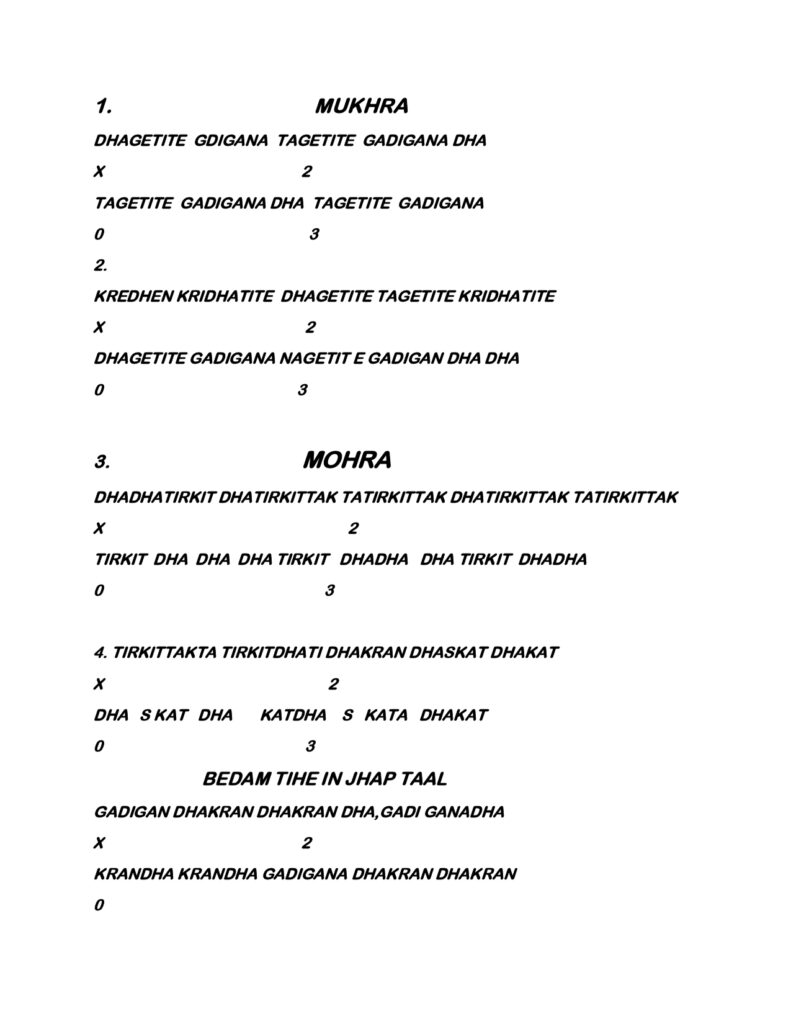
Jhaptaal consists of 10 beats (matras) divided into 4 sections (vibhags):
2 + 3 + 2 + 3
Clap pattern (taali/khali):
X (clap) | 2 (clap) | 0 (wave) | 3 (clap)
Basic theka:
Dhi Na | Dhi Dhi Na | Tin Na | Dhi Dhi Na
This asymmetry is what gives Jhaptaal its charm—it demands strong internal counting and rhythmic awareness.
What is a Mukhda?
A mukhda is a short rhythmic phrase that leads cleanly into the sam (first beat). Think of it as a musical landing phrase—brief, catchy, and precise.
10 Essential Jhaptaal Mukhdas
- Dha Ge Na – Dha (Sam)
- Ti Ta Ka – Dhi Na (Sam)
- Dha Ti Dha – Ge Na (Sam)
- Na Dhi Na – Dha (Sam)
- Dha Ge Dhi – Na (Sam)
- Ti Na Ka – Dhi Na (Sam)
- Dha – Trkt Dha – (Sam)
- Ge Na Dha – Dhi Na (Sam)
- Dha Ti Na – Dha (Sam)
- Dha Ge – Dha (Sam)
💡 Tip: Practice these starting from different matras—not just from beat 9 or 10—to build flexibility.
What is a Mohra?
A mohra is slightly more elaborate than a mukhda and often used to transition between sections or conclude improvisations. It typically has a flowing, melodic rhythmic structure.
Example Mohra in Jhaptaal
Dha Ge Na Dha | Ti Dha Ge Na | Dha – (Sam)
Another classic style:
Dha Trkt Dha Ge Na | Ti Dha Ge Na | Dha (Sam)
Mohlras often incorporate rela-like movement and can be expanded depending on tempo.
Bedam Tihai Explained
A tihai is a phrase repeated three times that resolves on the sam. A bedam tihai has no pauses (no rests) between repetitions—making it more challenging and fluid.
Structure Formula
Phrase × 3 = Ends on Sam
Example Bedam Tihai in Jhaptaal
Dha Ge Na Ti Na Ka Dha Ge Na Ti Na Ka Dha Ge Na Ti Na Ka (Sam)
Another example:
Dha Trkt Dha Ge Na Dha Trkt Dha Ge Na Dha Trkt Dha Ge Na (Sam)
The key is calculating the phrase length so all three repetitions land perfectly on beat 1.
💡 Practice Tip:
Count backward from sam. Jhaptaal’s 10 beats make tihai calculation trickier than in Teentaal—use slow tempo and clapping to internalize spacing.
Putting It All Together
To truly master Jhaptaal, you should combine these elements:
- Start with theka clarity
- Add simple mukhdas to land on sam
- Introduce mohra phrases for musical transitions
- Finish with bedam tihais for powerful resolution
Try this mini composition flow:
- Theka (2 cycles)
- Simple rela
- Mohra
- Bedam Tihai → Sam
This creates a complete and satisfying rhythmic arc.
Practice Routine (Daily 20-Min Plan)
- 5 min: Clap and recite Jhaptaal
- 5 min: Practice 3 mukhdas slowly
- 5 min: Work on 1 mohra
- 5 min: Build and test a bedam tihai
Consistency matters more than speed.
Quick Quiz 🎯
- How many beats are in Jhaptaal?
- What is the vibhag structure?
- What makes a tihai “bedam”?
- Where must every mukhda resolve?
Final Thoughts
Jhaptaal is where rhythm becomes a puzzle—and solving it is deeply rewarding. By mastering mukhda, mohra, and bedam tihai, you’re not just learning patterns; you’re developing timing, intuition, and expressive control.
The future of tabla lies in blending tradition with innovation, and Jhaptaal is the perfect playground for that exploration.
https://www.youtube.com/@BhagawanSingh
https://www.facebook.com/sbsinghtablaguru