
Introducing the-Master Jhaptaal Fast! 🥁 Kayda No. 2 Tutorial for Tabla Beginners (Dha Tirkit Dha Tite)
🥁 Exploring Jhaptaal Kayda No. 2
A Structured Journey into 10 Matras of Creativity, Tabla repertoire is built on strong foundations—and among them, the Kayda holds a special place. Today, we explore Jhaptaal Kayda No. 2, a composition set in the elegant and slightly asymmetrical rhythm cycle of Jhaptaal (10 matras). This kayda beautifully balances strength and grace through its bols and structure.
🌿 Understanding Jhaptaal
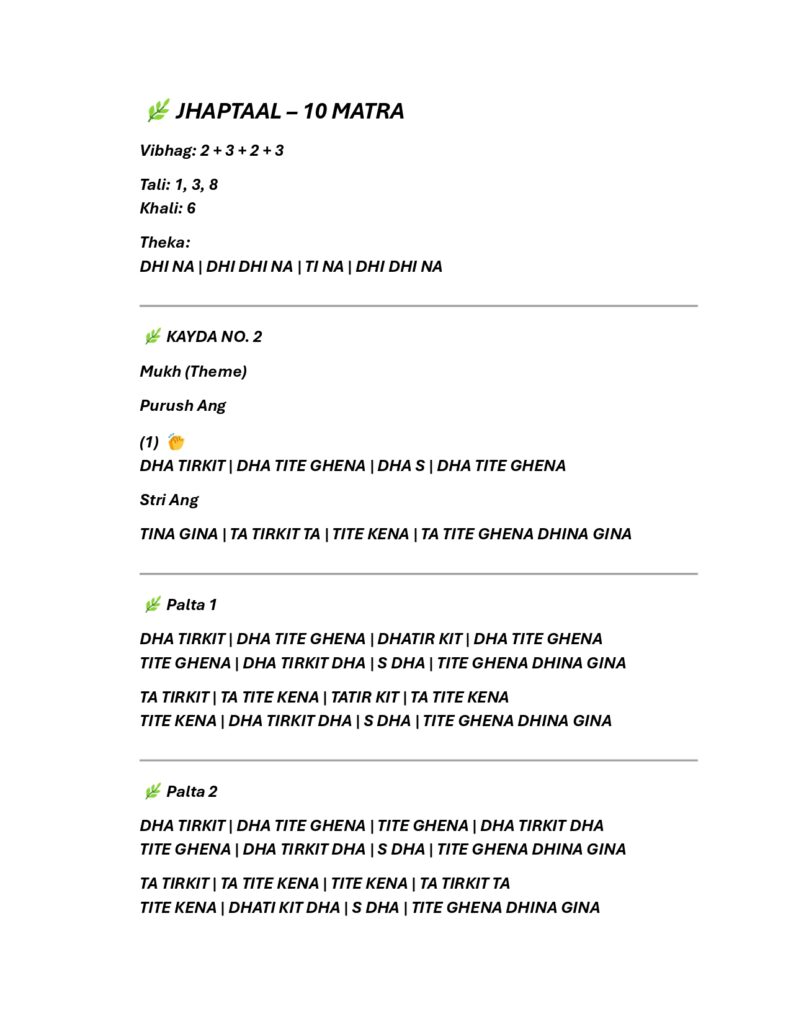
Jhaptaal consists of 10 matras, divided into 4 vibhags in the pattern:
2 + 3 + 2 + 3
Clap structure:
- Sam (1st matra) – 👏
- 2nd Tali (3rd matra) – 👏
- Khali (6th matra) – 👋
- 3rd Tali (8th matra) – 👏
The traditional theka of Jhaptaal is:
DHI NA | DHI DHI NA | TI NA | DHI DHI NA
This taal has a graceful swing because of its uneven grouping, making it perfect for expressive kaydas.
🌿 Kayda No. 2 – Mukh (Theme)
Here is the main composition (Mukh) of Kayda No. 2:
(Sam) 👏
DHA TIRKIT | DHA TITE GHENA | DHA S | DHA TITE GHENA
TINA GINA |
Let us understand this clearly within the 2+3+2+3 division:
| Vibhag | Bols |
|---|---|
| 2 | DHA TIRKIT |
| 3 | DHA TITE GHENA |
| 2 | DHA S |
| 3 | DHA TITE GHENA |
Then continues:
| Vibhag | Bols |
|---|---|
| 2 | TINA GINA |
| 3 | TA TIRKIT TA |
| 2 | TITE KENA |
| 3 | TA TITE GHENA DHINA GI |
This kayda beautifully alternates between powerful bols like DHA and flowing combinations like TIRKIT, TITE GHENA, and TINA GINA.
🥁 Structural Beauty of This Kayda
One of the most attractive aspects of Kayda No. 2 is its clear purush (strong) and stri (delicate) balance.
- DHA TIRKIT DHA TITE GHENA gives weight and authority.
- TINA GINA, TA TIRKIT TA bring lightness and agility.
The phrase “DHA S” in the third vibhag creates a pause-like openness, especially when it falls near the khali section. This gives breathing space before continuing the rhythmic flow.
The kayda strictly follows the rule of kayda development:
All variations (paltas) must use only the bols of the original theme.
So from:
DHA, TIRKIT, TITE, GHENA, S, TINA, GINA, TA, KENA, DHINA, GI
All paltas are derived.
🎵 Laykari and Flow
This kayda works beautifully in:
- Vilambit laya – for clarity and depth
- Madhya laya – for performance development
- Drut laya – for energetic presentation
The repeated use of TIRKIT creates rolling momentum.
The cluster TITE GHENA gives a smooth flowing texture.
When practiced slowly, each bol should be crystal clear:
- DHA – full bayan resonance
- TIRKIT – crisp and balanced
- TITE – sharp dayan strokes
- GHENA – controlled open sound
🎼 Performance Approach
When presenting this kayda in a solo:
- Play the theka of Jhaptaal clearly.
- Announce the kayda or begin directly from Sam.
- Maintain strong emphasis on the first DHA TIRKIT.
- Develop paltas gradually.
- Conclude with a well-calculated Tihai landing perfectly on Sam.
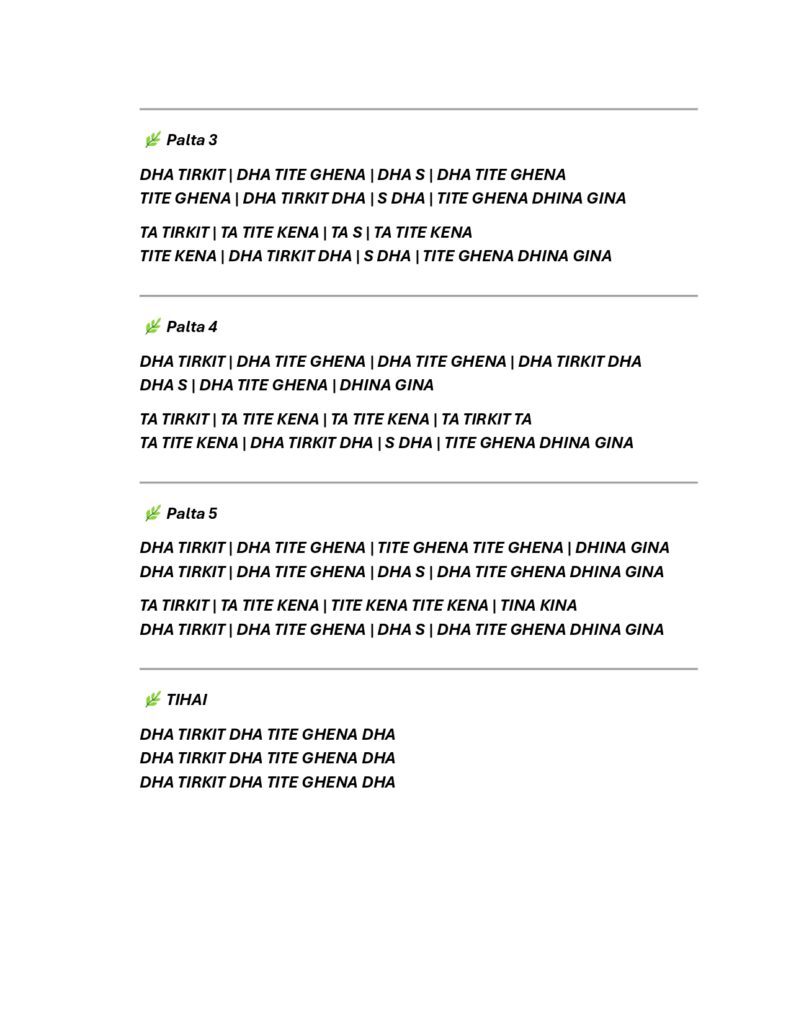
A sample tihai for this kayda could be based on:
DHA TIRKIT DHA TITE GHENA DHA
Repeated three times to resolve at Sam.
🌍 Why This Kayda Is Important
Jhaptaal is commonly used in:
- Classical vocal (Khayal)
- Instrumental music (Sitar, Sarod)
- Kathak dance accompaniment
Kayda No. 2 trains the student in:
- Handling uneven vibhag divisions
- Maintaining clarity in complex bols
- Balancing strength and softness
- Controlling laykari
Because Jhaptaal is not symmetrical like Teentaal, students develop better rhythmic awareness while practicing this kayda.
🧠 Practice Tips
✔ Count 1–10 continuously while playing.
✔ Emphasize Sam strongly.
✔ Keep Khali light but steady.
✔ Do not rush “TINA GINA.”
✔ Maintain equal spacing in “TITE GHENA.”
Practice first in slow tempo for at least 15–20 minutes daily before increasing speed.
✨ Final Reflection
Jhaptaal Kayda No. 2 is a brilliant example of how a simple set of bols can create endless rhythmic possibilities. Its strength lies in clarity, balance, and disciplined development.
When played correctly, this kayda does not just display technique—it expresses rhythm as conversation. The powerful opening DHA TIRKIT commands attention, while the flowing TINA GINA answers gracefully.
Master this kayda, and you will gain deeper control over Jhaptaal—and a stronger foundation for advanced tabla compositions.
https://www.facebook.com/sbsinghtablaguru