Introduction
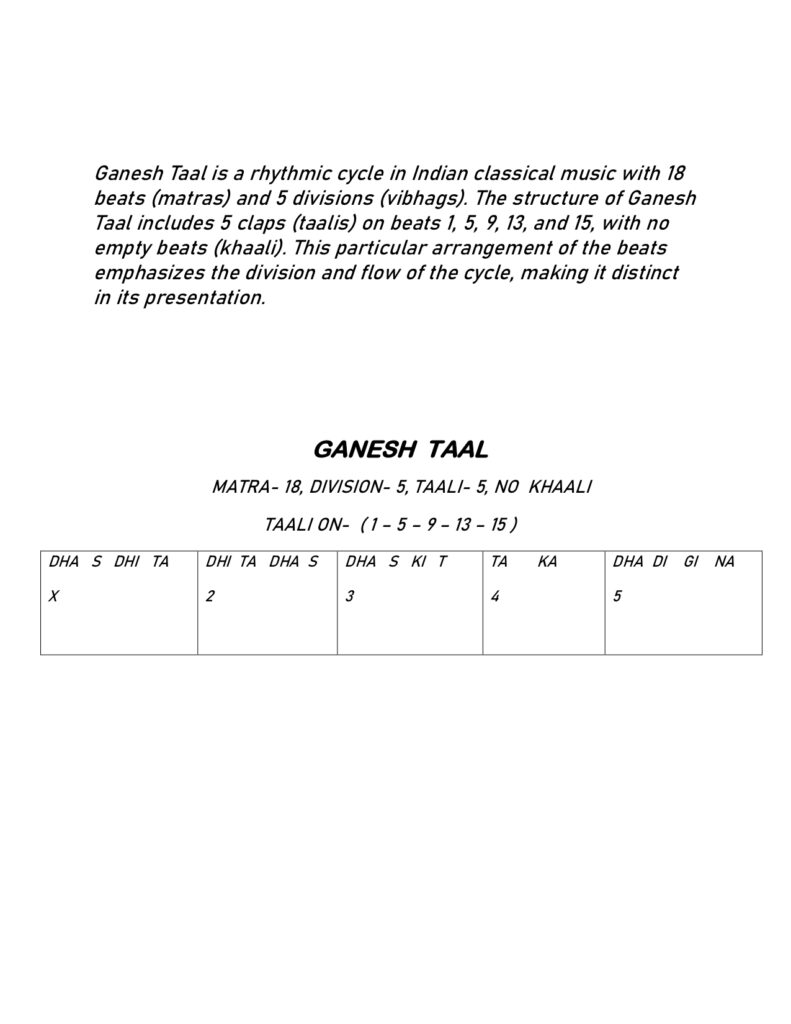
Tabla, the mesmerizing Indian percussion instrument, is known for its intricate rhythmic patterns, or taals. While common taals like Teentaal (16 beats) and Jhaptaal (10 beats) dominate the musical landscape, there are rare and unique rhythmic cycles that challenge even seasoned tabla players. One such intriguing rhythm is Ganesh Taal, an 18-beat cycle that is both complex and captivating. In this blog, we’ll explore the structure, composition, and notation of Ganesh Taal, along with its applications in Indian classical music.
Understanding Ganesh Taal
Ganesh Taal is an 18-matra (beat) cycle, making it an unusual rhythmic framework in tabla playing. Unlike the more symmetrical 16-beat Teentaal, Ganesh Taal has an asymmetric feel, providing a distinct groove that challenges both musicians and listeners. This taal is commonly associated with devotional and classical performances, particularly in compositions dedicated to Lord Ganesha.
Structure of Ganesh Taal
Ganesh Taal is structured into four divisions (Vibhags), grouped as:
📌 6 + 6 + 2 + 4
This asymmetrical arrangement gives the taal a dynamic and unpredictable character, making it stand out among traditional cycles.
Basic Theka (Bol Pattern) of Ganesh Taal
The theka (basic beat pattern) of Ganesh Taal is as follows:
👉 Dha Dhin Dhin Dha | Dha Tin Tin Ta | Tin Tin | Dha Dhin Dhin Dha
Each division of the taal has its own weight and flow, making it essential for tabla players to understand the accents and pauses to maintain the groove.
Notation of Ganesh Taal
Here is the detailed notation breakdown for Ganesh Taal in matra-wise format:
| Matra | Bol (Stroke) |
|---|---|
| 1 | Dha |
| 2 | Dhin |
| 3 | Dhin |
| 4 | Dha |
| 5 | Dha |
| 6 | Tin |
| 7 | Tin |
| 8 | Ta |
| 9 | Tin |
| 10 | Tin |
| 11 | (Rest) |
| 12 | Dha |
| 13 | Dhin |
| 14 | Dhin |
| 15 | Dha |
| 16 | Dha |
| 17 | Tin |
| 18 | Ta |
This structure provides a balanced yet unpredictable rhythm, which makes Ganesh Taal an exciting challenge for tabla players.
Compositions & Applications of Ganesh Taal
Ganesh Taal is often used in bhajans, classical compositions, and experimental fusion music. Since it is an odd-numbered rhythmic cycle, it requires musicians to have a strong sense of timing and improvisation.
Famous Uses of Ganesh Taal:
🎵 Devotional Songs: Many bhajans dedicated to Lord Ganesha incorporate this taal.
🎵 Kathak Performances: Used in rare Kathak dance compositions.
🎵 Fusion Music: Some modern tabla artists experiment with Ganesh Taal in Indo-Western collaborations.
How to Practice Ganesh Taal?
If you’re a tabla player looking to master Ganesh Taal, here are a few steps:
✅ Start Slow: Practice each vibhag separately to get comfortable.
✅ Use a Metronome: Maintain precision in timing.
✅ Recite the Bols: Clapping and reciting the bol pattern helps internalize the taal.
✅ Experiment with Variations: Once comfortable, try different kaidas and tukras within the 18-beat framework.
Conclusion
Ganesh Taal is a rare and captivating rhythmic cycle in Indian classical music. Its 18-beat structure, combined with its asymmetrical vibhags, makes it a unique and challenging taal for tabla players. Whether you are a beginner or an advanced tabla enthusiast, mastering Ganesh Taal will enhance your rhythmic skills and musical creativity.
💬 Have you tried playing Ganesh Taal? Share your experience in the comments!
🔗 Looking for a tutorial? Check out this Ganesh Taal video lesson to practice along!
🎶 Keep exploring rhythms and let the taal guide your musical journey! 🎵
https://www.youtube.com/@BhagawanSingh
https://www.facebook.com/groups/670083084236947