
Indication of the-Deepchandi Taal (14 Beats) Tukra – Beauty, Balance, and Classical Grace
Deepchandi Taal is one of the most graceful and expressive taals in Indian classical music. Consisting of 14 beats, this taal is widely used in Vilambit and Madhya laya compositions, especially in khayal, thumri, bhajan, and semi-classical forms. When performed on tabla, a Deepchandi Taal Tukra beautifully highlights the balance between rhythm, melody, and aesthetic clarity.
Understanding Deepchandi Taal (14 Beats)
Deepchandi Taal is structured as 3 + 4 + 3 + 4, making its flow smooth yet distinct. The sam (first beat) carries great importance, while the khali (empty beat) creates space and contrast within the cycle. Because of its lyrical nature, Deepchandi Taal allows the tabla player to explore soft dynamics, clear bols, and expressive phrasing rather than sheer speed. The theka of Deepchandi Taal is gentle and flowing, which makes it ideal for tukras that emphasize precision and elegance. Unlike fast taals such as Teentaal, Deepchandi encourages restraint, musical sensitivity, and refined timing.
What Is a Tukra in Tabla?
A tukra is a short, fixed tabla composition that usually ends with a tihai and lands perfectly on the sam. Tukras are often performed during solos or accompaniment breaks to showcase creativity, control, and rhythmic intelligence. In Deepchandi Taal, a tukra must respect the taal’s calm nature while still providing rhythmic interest.
A Deepchandi tukra typically uses simple yet powerful bols, arranged thoughtfully to complement the taal’s structure. The beauty lies not in complexity alone, but in how naturally the composition resolves back to the sam.
Importance of Deepchandi Tukra in Tabla Training
For tabla students, learning a Deepchandi Taal tukra is extremely beneficial. It helps develop:
- Strong laya control
- Clear understanding of 14-beat cycles
- Sensitivity to khali and sam
- Graceful hand movement and sound clarity
Because Deepchandi is often played at slower tempos, any mistake in timing becomes immediately noticeable. This trains the student to play with discipline, patience, and awareness—qualities essential for advanced tabla playing.
Bols and Composition Style
A Deepchandi Taal tukra commonly includes bols like Dha, Dhin, Na, Tin, Ta, Tirkit, and soft resonant sounds that blend well with melodic accompaniment. The tukra is carefully structured so that its final tihai resolves exactly on the sam, reinforcing the rhythmic cycle.
In performance, a well-played Deepchandi tukra sounds effortless and musical, even though it requires deep internal counting and rhythmic maturity.
Role in Performance and Accompaniment
Deepchandi Taal tukras are frequently used during thumri and light classical performances, where the tabla player must enhance the mood without overpowering the vocalist or instrumentalist. A tasteful tukra adds color and excitement while maintaining the emotional flow of the composition. In solo tabla performances, Deepchandi tukras act as moments of calm sophistication, offering contrast to faster taals and energetic compositions.
Why Deepchandi Taal Remains Timeless
The enduring popularity of Deepchandi Taal lies in its emotional depth and rhythmic elegance. It bridges the gap between strict classical rhythm and expressive musical storytelling. A tukra in this taal reflects not just technical skill, but also the artist’s musical understanding and aesthetic sense. For listeners, Deepchandi Taal tukras are soothing yet engaging. For performers, they are a test of control, balance, and rhythmic intelligence.
Conclusion
The Deepchandi Taal (14 Beats) Tukra is a shining example of how simplicity and structure can create profound musical beauty. Whether you are a tabla student, performer, or listener, exploring Deepchandi tukras deepens your appreciation for rhythm and classical artistry. Mastering this taal is not just about counting beats—it is about feeling the flow, respecting silence, and arriving at the sam with confidence and grace. In the world of tabla, Deepchandi Taal remains a symbol of refinement, tradition, and timeless musical expression. Deepchandi Taal is a beautiful 14-beat cycle primarily used in semi-classical music like Thumri and Ghazal. It has a distinctive “swaying” feel created by its 3-4-3-4 division.
Below are 6 compositions (Tukras and Mukhras) ranging from simple to more rhythmic, designed to fit this 14-beat cycle perfectly.
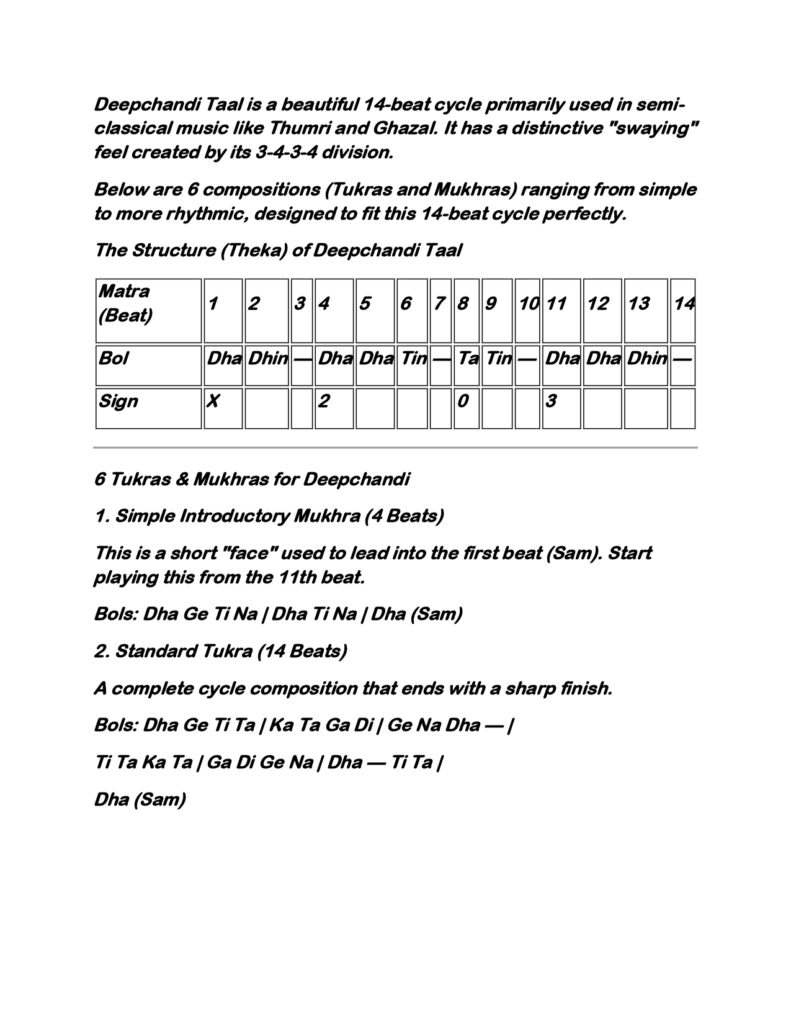
The Structure (Theka) of Deepchandi Taal
| Matra (Beat) | 1 | 2 | 3 | 4 | 5 | 6 | 7 | 8 | 9 | 10 | 11 | 12 | 13 | 14 |
| Bol | Dha | Dhin | — | Dha | Dha | Tin | — | Ta | Tin | — | Dha | Dha | Dhin | — |
| Sign | X | 2 | 0 | 3 |
6 Tukras & Mukhras for Deepchandi
1. Simple Introductory Mukhra (4 Beats)
This is a short “face” used to lead into the first beat (Sam). Start playing this from the 11th beat.
Bols: Dha Ge Ti Na | Dha Ti Na | Dha (Sam)
2. Standard Tukra (14 Beats)
A complete cycle composition that ends with a sharp finish.
Bols: Dha Ge Ti Ta | Ka Ta Ga Di | Ge Na Dha — |
Ti Ta Ka Ta | Ga Di Ge Na | Dha — Ti Ta |
Dha (Sam)
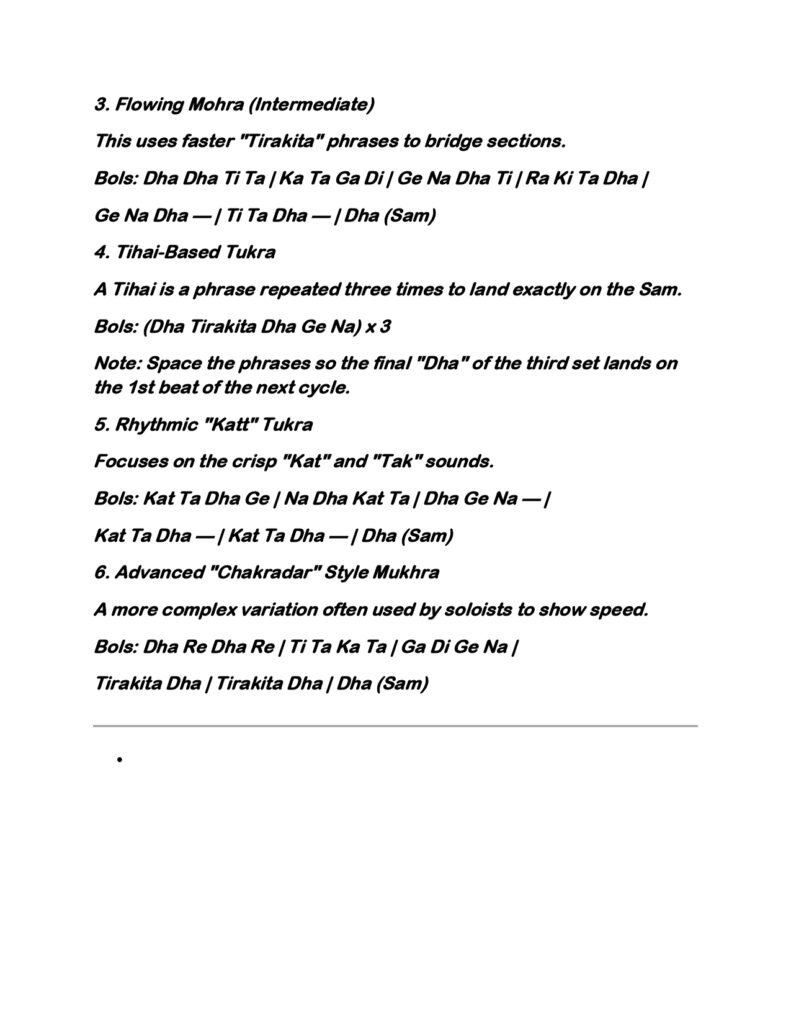
3. Flowing Mohra (Intermediate)
This uses faster “Tirakita” phrases to bridge sections.
Bols: Dha Dha Ti Ta | Ka Ta Ga Di | Ge Na Dha Ti | Ra Ki Ta Dha |
Ge Na Dha — | Ti Ta Dha — | Dha (Sam)
4. Tihai-Based Tukra
A Tihai is a phrase repeated three times to land exactly on the Sam.
Bols: (Dha Tirakita Dha Ge Na) x 3
Note: Space the phrases so the final “Dha” of the third set lands on the 1st beat of the next cycle.
5. Rhythmic “Katt” Tukra
Focuses on the crisp “Kat” and “Tak” sounds.
Bols: Kat Ta Dha Ge | Na Dha Kat Ta | Dha Ge Na — |
Kat Ta Dha — | Kat Ta Dha — | Dha (Sam)
6. Advanced “Chakradar” Style Mukhra
A more complex variation often used by soloists to show speed.
Bols: Dha Re Dha Re | Ti Ta Ka Ta | Ga Di Ge Na |
Tirakita Dha | Tirakita Dha | Dha (Sam)
Tips for Practice
Laya (Tempo): Practice these in Madhya Laya (medium tempo) first, as Deepchandi loses its beauty if played too fast like a Teental.
Emphasize the “Khali”: Beat 8 is the “empty” beat (Khali). Make sure your left hand (Bayan) is silent or very soft here to maintain the taal’s character.
The “S” (Pause): Deepchandi relies on the gaps. Don’t rush through the silent beats (marked as “—” or “S”); they provide the “swing.”
https://www.facebook.com/sbsinghtablaguru
https://www.youtube.com/@BhagawanSingh