
Barahi Chakardar Tihai in Teentaal – 16 Beats | Step-by-Step Guide
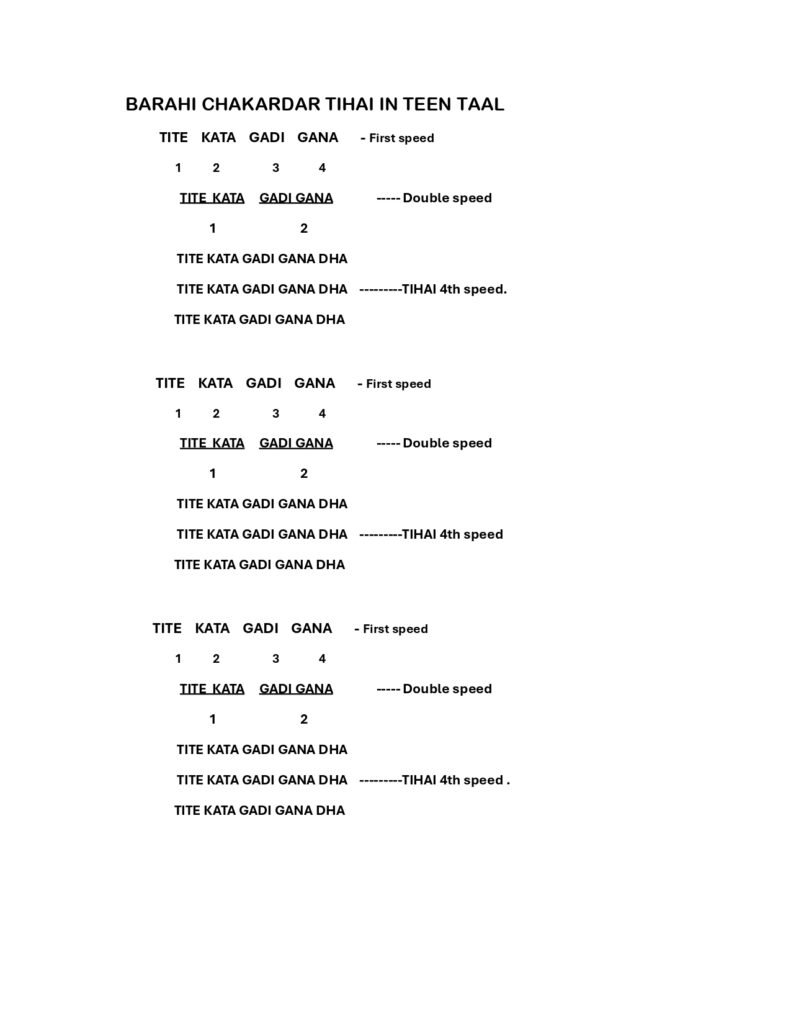
The Barahi Chakardar Tihai is an exciting rhythmic composition for tabla students who want to move beyond basic tihais and explore the beauty of mathematical rhythm. Played within Teentaal, the 16-beat taal of Hindustani classical music, a Chakardar Tihai requires careful counting, clear bols, and excellent control of laya.
For tabla learners, practicing this type of composition is a wonderful way to improve timing, concentration, hand coordination, and understanding of the taal cycle.
In this guide, we will understand the basic structure of Teentaal and then look at how to approach a Barahi Chakardar Tihai step by step.
What Is Teentaal?
Teentaal is one of the most popular taals in Hindustani classical music. It contains 16 matras (beats) arranged into four equal sections, or vibhags, of four beats each.
Its basic structure is:
4 + 4 + 4 + 4 = 16 matras
The traditional theka is:
Dha Dhin Dhin Dha | Dha Dhin Dhin Dha | Dha Tin Tin Ta | Ta Dhin Dhin Dha
The four sections are marked by clap, clap, wave, and clap:
1 2 3 4 | 5 6 7 8 | 9 10 11 12 | 13 14 15 16
Understanding this 16-beat framework is essential before attempting a Chakardar Tihai.
What Is a Tihai?
A Tihai is a rhythmic phrase that is performed three times, normally designed to arrive precisely on Sam, the first beat of the taal cycle.
For example, if a phrase is:
TITE KATA GADI GANA DHA
then repeating it three times creates the basic idea of a Tihai:
TITE KATA GADI GANA DHA
TITE KATA GADI GANA DHA
TITE KATA GADI GANA DHA
The important part is not simply repeating the phrase. The phrase and the spaces between repetitions must be calculated so that the final stroke lands correctly on Sam.
What Is a Chakardar Tihai?
A Chakardar Tihai is a more elaborate form of Tihai in which a larger rhythmic composition is repeated three times.
Think of it as:
Composition → Composition → Composition
The complete structure creates a satisfying rhythmic “circle” that returns to Sam.
The word Chakardar is associated with the idea of a circular or recurring rhythmic design. These compositions are particularly enjoyable in tabla performance because the listener can hear the phrase develop and finally resolve dramatically onto Sam.
Understanding the Barahi Chakardar Tihai
The Barahi Chakardar Tihai should be approached gradually. Before trying to play it at speed, first understand its bol structure and rhythmic placement.
A useful practice sequence is:
Step 1: Learn each bol separately.
Step 2: Speak the bols clearly.
Step 3: Play the phrase slowly.
Step 4: Count the matras of Teentaal.
Step 5: Repeat the composition three times.
Step 6: Check that the final stroke reaches Sam.
Do not rush through the composition. In tabla, clarity and accurate timing are more important than speed.
Step-by-Step Practice
Step 1: Establish the 16-Beat Cycle
Begin by reciting:
1 2 3 4 | 5 6 7 8 | 9 10 11 12 | 13 14 15 16
Then return to:
1
That first beat is Sam.
Step 2: Practice the Bols
If your composition contains phrases such as:
TITE KATA GADI GANA DHA
practice them slowly and evenly.
First speed:
TITE | KATA | GADI | GANA | DHA
Then gradually develop the required laya while maintaining clean articulation.
Step 3: Practice the Tihai
Now repeat the phrase three times:
TITE KATA GADI GANA DHA
TITE KATA GADI GANA DHA
TITE KATA GADI GANA DHA
Listen carefully for the point where the final DHA meets Sam.
Step 4: Add the Teentaal Theka
Once the composition is comfortable, practice it against the Teentaal framework:
Dha Dhin Dhin Dha | Dha Dhin Dhin Dha | Dha Tin Tin Ta | Ta Dhin Dhin Dha
This helps you understand where the composition sits inside the taal.
Why Counting Matters
A common mistake among students is trying to memorize a Chakardar only through sound. Memorization is useful, but understanding the mathematics of the composition makes it much easier to reproduce accurately.
Count the beats, identify the starting point, and determine where each repetition begins. This develops your sense of laya and matra, two essential elements of tabla playing.
Practice Tips for Beginners
Start slowly with a metronome or tabla lehra if available. Keep your hands relaxed and pronounce every bol clearly.
Try this progression:
Slow → Medium → Controlled Fast
Do not increase the speed until the phrase remains accurate.
You can also recite the composition while clapping the Teentaal structure. This connects your voice, hands, and rhythmic awareness.
Conclusion
The Barahi Chakardar Tihai in Teentaal is an excellent composition for developing advanced rhythmic understanding. It combines the excitement of a three-part Tihai with the 16-beat framework of Teentaal.
The secret to mastering it is simple: learn the bols, understand the matras, maintain the laya, and always know where Sam is.
With regular practice, patience, and guidance from a knowledgeable tabla teacher, students can gradually develop the confidence to perform Chakardar compositions with clarity and precision.
🥁 Keep practicing, keep counting, and let every phrase resolve beautifully on Sam!
Tabla Nawaz Academy — Learn • Practice • Perform • Excel.