
Master Rupak Taal – 7 Beats Laggi: Fast & Easy Tabla Tutorial
Introduction: Discover the Rhythm of Rupak Taal
Want to make your tabla playing more exciting with fast, catchy rhythms? Welcome to Rupak Taal Laggi – Fast & Easy Tabla Tutorial! Rupak Taal is one of the most interesting rhythmic cycles in Hindustani classical music. With seven matras (beats), it offers a wonderful balance of melody, rhythm, and creativity.
Whether you’re a beginner learning your first tabla compositions or an intermediate player looking to improve your speed, this tutorial will help you understand Rupak Taal and explore exciting laggi patterns.
The best part? You can start practising slowly and gradually build speed, clarity, and confidence.
1. What Is Rupak Taal?
Rupak Taal is a popular taal in Indian classical music consisting of seven matras divided into three sections: 3 + 2 + 2.
Its traditional theka is commonly written as:
Tin Tin Na | Dhin Na | Dhin Na
Count the beats like this:
1 – 2 – 3 | 4 – 5 | 6 – 7
Rupak Taal has a distinctive feature: its first beat is khali (the empty or unstressed section), while the fourth beat is the first tali (clap).
This creates a unique rhythmic feeling that distinguishes Rupak from other taals, such as Teentaal, which has sixteen beats.
2. Understanding Laggi in Tabla
Laggi is a lively rhythmic style often heard in lighter classical music, thumri, dadra, folk music, and musical accompaniment. It uses flowing, energetic bol combinations to make the rhythm more playful and expressive.
Unlike simply repeating the basic theka, laggi introduces variations that bring movement and excitement to a performance.
Common laggi bols include:
- DHA
- TIRKIT
- TAK
- DHATI
- DHITA
- TATI
- TITA
These bols can be combined in different ways to create interesting rhythmic phrases. The goal is not just to play quickly but to maintain clear articulation and a steady rhythmic cycle.
3. Learn Your First Rupak Taal Laggi
Let’s begin with a simple practice pattern inspired by traditional tabla bol vocabulary.
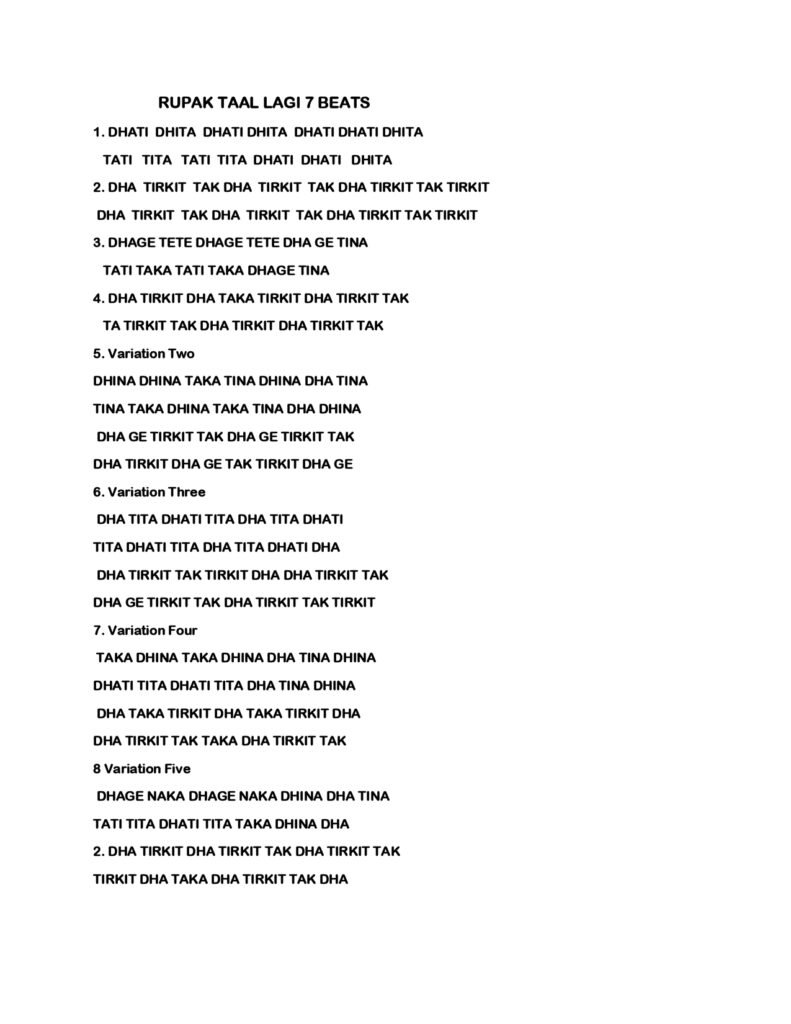
Pattern 1: Dhati Dhita Laggi
DHATI DHITA | DHATI DHITA | DHATI DHATI DHITA
TATI TITA | TATI TITA | DHATI DHATI DHITA
Start slowly and pronounce each bol clearly. Practise the first line until it feels comfortable, then add the second line.
Pattern 2: Dha Tirkit Tak Laggi
DHA TIRKIT TAK | DHA TIRKIT TAK
DHA TIRKIT TAK | TIRKIT
Repeat the pattern evenly and listen carefully to how the lighter bols contrast with the strong DHA strokes.
These are practice phrases inspired by laggi-style playing. To fit a composition precisely into Rupak Taal, count the matras and adjust the phrase lengths to match the seven-beat cycle.
4. How to Practise Laggi Faster
Speed comes from control, not force. Follow these four steps:
Step 1: Start slowly. Play each bol at a comfortable tempo, focusing on clean sound.
Step 2: Maintain the taal. Count all seven matras while playing. Avoid losing the cycle when a phrase becomes complicated.
Step 3: Use a metronome or lehra. A steady melodic accompaniment can help you recognise where each cycle begins.
Step 4: Increase speed gradually. Once the pattern sounds clear and even, raise the tempo slightly. Return to a slower speed whenever your strokes become unclear.
Practise for five to ten minutes at a time, allowing yourself short breaks between sessions.
5. Common Mistakes to Avoid
Many students focus on speed before mastering the basic rhythm. This can lead to uneven strokes and confusion about where the taal cycle begins.
Remember these tips:
- Keep your hands relaxed.
- Make each bol sound distinct.
- Count the seven matras consistently.
- Practise with a tanpura, lehra, or metronome when possible.
- Listen to experienced tabla players to understand phrasing and musical expression.
Most importantly, remember that laggi should complement the music rather than overwhelm it.
6. Take Your Tabla Playing to the Next Level
Once you are comfortable with the basic patterns, experiment with different combinations of DHATI, DHITA, TIRKIT, TAK, and DHA. Try playing a phrase softly, then repeat it with more energy while keeping the underlying rhythm steady.
You can also practise alongside recordings of Rupak Taal performances and compare how different musicians use rhythmic variations.
For additional learning, explore tabla lessons, demonstrations of the Rupak theka, and recordings of accomplished tabla maestros. Listening regularly will help you develop a stronger sense of timing and musical expression.
Conclusion: Master Rupak Taal One Beat at a Time
Rupak Taal is a beautiful seven-beat rhythm that offers endless possibilities for creativity. By learning its structure, practising laggi patterns, and gradually improving your speed, you can make your tabla playing more confident and expressive.
Remember: slow practice builds accuracy, steady counting builds rhythm, and regular practice builds speed.
Pick up your tabla, begin with the basic theka, and explore your own laggi variations!
Your challenge: Can you play a clear Rupak Taal laggi pattern at three different speeds without losing the seven-beat cycle? Practise, record yourself, and share your progress with fellow tabla learners.
https://www.youtube.com/@BhagawanSingh
https://www.facebook.com/sbsinghtablaguru