
,Master Jhaptaal Kayda No-2 Like a Pro: Dha Dha Tirkit, Jhaptaal Kayda No-2 Like a Pro: Dha Dha Tirkit, Play Jhaptaal Kayda No. 2 Like a Pro: Dha Dha Tirkit Dha Tuna Dha, If you are learning tabla and want to strengthen your command over Jhaptaal, Kayda No. 2 is a fantastic exercise to add to your practice routine. The phrase “Dha Dha Tirkit Dha Tuna Dha” may sound simple at first, but when played with the correct taal structure, clarity, speed, and balance, it becomes a powerful tabla composition.
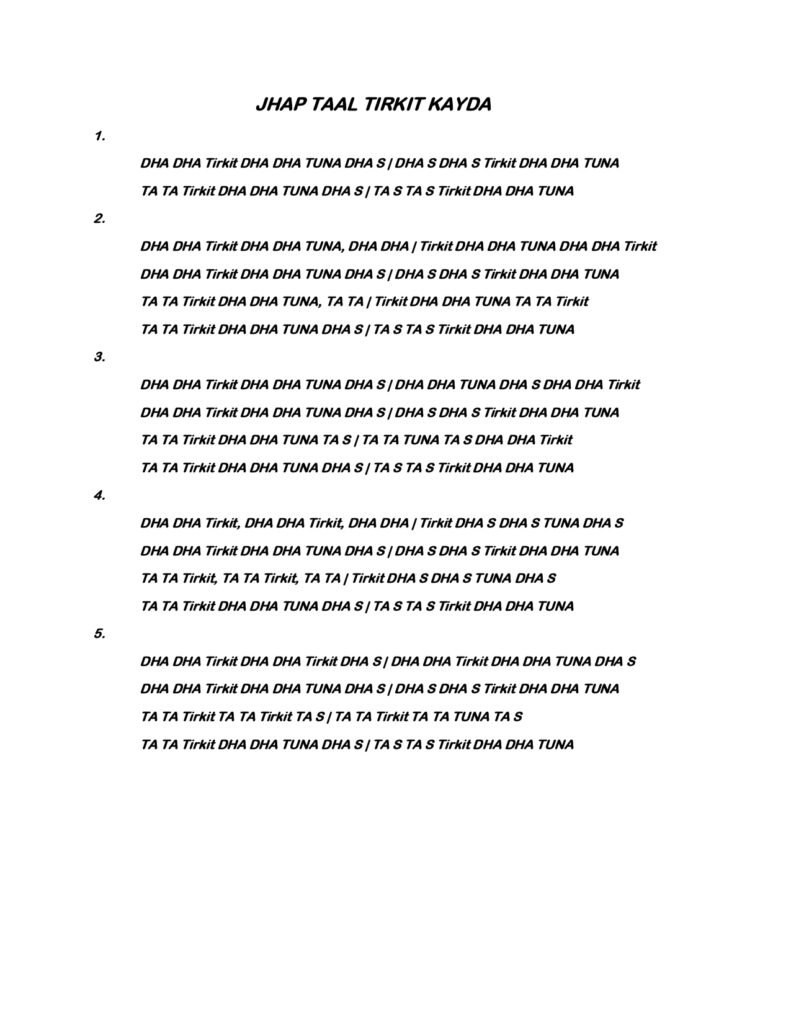
Jhaptaal is a 10-matra taal commonly used in Hindustani classical music. Its distinctive division of 2 + 3 + 2 + 3 gives it a lively, slightly asymmetrical character. Learning a kayda in this taal helps develop both rhythmic awareness and technical control.
Understanding Jhaptaal
Before playing Kayda No. 2, make sure you are comfortable counting the 10 matras:
1 2 | 3 4 5 | 6 7 | 8 9 10
The traditional tali-khali structure is:
Dha Dhin | Dhin Dha Tin | Na | Dhin Dhin Dha Tin | Na
Depending on the gharana and teaching tradition, bols and presentation can vary, but the underlying 10-matra cycle remains the foundation.
The most important thing is to feel the vibhags rather than simply counting from 1 to 10 mechanically.
The Main Phrase: Dha Dha Tirkit Dha Tuna Dha
The central phrase for this kayda is:
Dha Dha Tirkit Dha Tuna Dha
This phrase combines open and articulated bols with Tirkit, making it especially useful for developing finger coordination.
Try saying it slowly:
Dha — Dha — Tir-kit — Dha — Tu-na — Dha
Don’t rush the Tirkit. Each syllable should be distinct and controlled.
Why Tirkit Matters
The Tirkit phrase is an important part of tabla technique. It requires quick, coordinated finger movements and becomes increasingly challenging as you increase the tempo.
A common mistake among students is to treat Tirkit as one blurred sound. Instead, practice:
Tir – Kit
Tir – Kit
Tir – Kit
Then connect it smoothly with the surrounding bols:
Dha Dha | Tirkit | Dha | Tuna | Dha
The goal is not simply speed. The goal is clarity at every speed.
How to Practice Kayda No. 2
Start with a slow tempo. Use a metronome or tabla lehra if available, and maintain a steady Jhaptaal cycle.
Step 1: Recite
First recite:
Dha Dha Tirkit Dha Tuna Dha
Repeat it several times without playing. Listen carefully to the pronunciation and internalize the rhythmic shape.
Step 2: Play Slowly
Move to the tabla and play the phrase slowly. Keep your hands relaxed and avoid unnecessary tension.
At this stage, focus on:
- Clean Dha strokes
- Even Tirkit
- Clear Tuna
- Consistent volume
- A steady pulse
Step 3: Practice With Jhaptaal
Now place the phrase within the 10-matra cycle.
Count:
1 2 | 3 4 5 | 6 7 | 8 9 10
Your objective is to remain connected to the taal while playing the composition. Don’t allow the technical movements to make you lose the sam.
From Slow Speed to Fast Speed
Once the phrase is comfortable, gradually increase the tempo.
A useful progression is:
Vilambit → Madhya → Drut
At every stage, ask yourself:
“Is my Tirkit still clear?”
If the answer becomes no, reduce the speed. Developing speed by sacrificing clarity can create bad habits that are difficult to correct later.
A professional-sounding performance comes from control, not simply playing fast.
Common Mistakes to Avoid
1. Rushing Tirkit
Students often accelerate during Tirkit because of the quick finger movement. Keep the subdivisions even.
2. Weak Dha
The Dha should have a confident, centered sound. Avoid allowing the first bols of the phrase to become too soft.
3. Losing the Sam
Jhaptaal has a distinctive cycle, so always know where sam is. Practice clapping and reciting the taal separately from the kayda.
4. Excessive Hand Tension
Relax your wrists and fingers. If your hands become stiff, stop and reset before continuing.
Take Your Kayda to the Next Level
Once Dha Dha Tirkit Dha Tuna Dha feels natural, practice it at several tempos while maintaining the same rhythmic discipline. You can also record yourself and listen back for uneven Tirkit strokes or changes in volume.
The next step is to learn the full Kayda No. 2, including its variations and tihai, rather than practicing only the opening phrase. This teaches you how a tabla kayda develops while staying connected to the original theme.
Final Thoughts
Jhaptaal Kayda No. 2 — “Dha Dha Tirkit Dha Tuna Dha” is more than a sequence of bols. It is an exercise in coordination, rhythm, articulation, and musical discipline.
Start slowly. Recite before playing. Keep the Tirkit clean. Feel all 10 matras. Most importantly, don’t chase speed before developing control.
With consistent practice, this simple phrase can become the foundation for much more advanced Jhaptaal playing.
https://www.youtube.com/@BhagawanSingh