
Aari Kuwari Kayda No. 3 in Teen Taal: Dha Tirkit Tak Tirkit
Introduction
In the rich vocabulary of tabla, a kayda is one of the most important forms for developing rhythmic control, clarity, speed, and improvisational ability. Among the many kaydas practiced by tabla students, Aari Kuwari Kayda No. 3, built around the phrase “Dha Tirkit Tak Tirkit,” offers an excellent study in bols, balance, repetition, and variation.
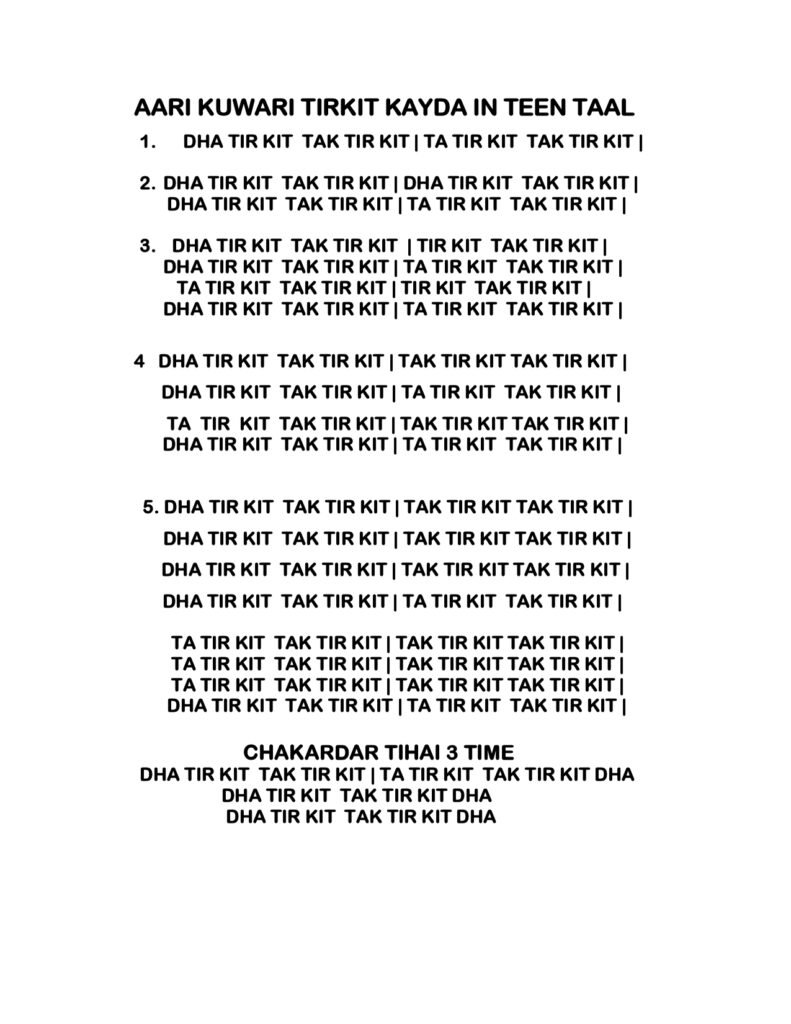
This kayda is commonly practiced in Teen Taal (Tintal), the sixteen-matra rhythmic cycle that is fundamental to Hindustani classical tabla. Its four equal sections make it particularly suitable for learning how a composed tabla phrase sits inside a complete taal cycle.
The phrase:
Dha Tirkit Tak Tirkit
contains a combination of open and closed sounds that can be developed into a complete kayda and subsequently expanded through several paltas. For students, this makes the composition more than a memorization exercise. It becomes a practical lesson in maintaining the taal while changing the internal arrangement of bols.
In this article, we will explore Aari Kuwari Kayda No. 3, understand its relationship with Teen Taal, examine its bols, discuss practice techniques, and look at how a student can gradually develop speed and confidence while preserving clarity.
Understanding Teen Taal
Before studying the kayda, it is essential to understand the taal in which it is performed.
Teen Taal consists of 16 matras divided into four vibhags of four matras each:
4 + 4 + 4 + 4 = 16
Its traditional tali-khali structure is:
- 1 — Sam — Taali
- 5 — Taali
- 9 — Khali
- 13 — Taali
A common theka is:
Dha Dhin Dhin Dha | Dha Dhin Dhin Dha | Dha Tin Tin Ta | Ta Dhin Dhin Dha
The sam, the first beat of the cycle, is particularly important. It is the point toward which rhythmic phrases resolve.
For a tabla player practicing a kayda, knowing exactly where the sam falls is crucial. Even when the bols become fast and complicated, the player must retain an internal sense of all sixteen matras.
What Is a Kayda?
The word kayda is associated with the idea of a rule, method, or established framework. In tabla performance, a kayda generally begins with a composed theme called the mukh, followed by variations called paltas.
A traditional kayda follows an important principle:
The fundamental character and vocabulary of the original kayda should remain recognizable through its variations.
The player does not simply invent random combinations of bols. Instead, the original material provides a rhythmic and technical framework.
A typical presentation may follow this sequence:
Theka → Kayda Mukh → Paltas → Rela or further development → Tihai/Ending
The exact performance structure varies according to the gharana, teacher, repertoire, and artistic context.
Aari Kuwari Kayda No. 3
The identifying phrase of this kayda is:
Dha Tirkit Tak Tirkit
The bols themselves are important because they combine several fundamental tabla strokes.
The basic bols
Dha
Dha is generally produced by combining the sounds of the dayan and bayan. It is an open, resonant bol and is one of the most recognizable sounds in tabla.
Tirkit
“Tirkit” is a compound rhythmic phrase involving rapid articulation on the dayan. Depending on the player’s technique and gharana tradition, the exact fingering and articulation can differ.
Tak
Tak is a relatively crisp, dry stroke. It provides contrast to the resonance of Dha and helps create rhythmic definition.
The combination:
Dha – Tirkit – Tak – Tirkit
creates an interesting contrast between resonance and articulation.
Why “Dha Tirkit Tak Tirkit” Is Technically Interesting
At first glance, the phrase may appear simple. However, its usefulness becomes apparent when it is repeated at different speeds.
The opening Dha provides a strong point of articulation.
The first Tirkit introduces a compact group of rapid strokes.
Tak creates a clear change in tonal character.
The second Tirkit returns to the rapid articulation.
This alternation can help students develop:
- Finger coordination
- Stroke consistency
- Speed control
- Dynamic control
- Internal pulse
- Hand independence
- Rhythmic memory
A common mistake among beginners is to concentrate exclusively on playing the bols quickly. In reality, clarity should come before speed.
A slow, clean Tirkit is much more useful than a fast Tirkit in which individual strokes become indistinct.
Practicing the Kayda in Teen Taal
The first step is to establish a steady Teen Taal cycle.
Count:
1 2 3 4 | 5 6 7 8 | 9 10 11 12 | 13 14 15 16
Then identify the four vibhags:
1–4 | 5–8 | 9–12 | 13–16
Maintain the theka internally or with a lehra while practicing the kayda.
The next stage is to speak the composition.
Try saying:
Dha Tirkit Tak Tirkit
slowly and evenly.
Do not immediately attempt a high speed. First make sure that every syllable has a consistent rhythmic position.
Bol Recitation: An Essential Practice
Tabla tradition places great importance on bol recitation.
Before playing the kayda, speak it clearly.
For example:
Dha — Tirkit — Tak — Tirkit
Then repeat it without the tabla.
After the verbal rhythm becomes comfortable, play it slowly.
This three-stage approach is highly effective:
Stage 1: Speak
Learn the sound and rhythmic placement.
Stage 2: Play Slowly
Concentrate on tone and finger movement.
Stage 3: Increase Speed
Gradually increase the tempo while maintaining the same rhythmic structure.
A metronome can be useful during practice, but students should also practice with a lehra because it develops a stronger sense of the taal cycle.
Developing Paltas
The real beauty of a kayda appears when the player begins working with paltas.
A palta is a variation derived from the original kayda.
For the phrase:
Dha Tirkit Tak Tirkit
the student can investigate different permutations while respecting the vocabulary and structure of the composition.
For example, one can practice separating the components:
Dha Tirkit | Tak Tirkit
Then explore the relationship between:
Dha + Tirkit
and
Tak + Tirkit
The purpose is not merely to rearrange words. The variation must remain rhythmically connected to the original kayda.
This is where a teacher’s guidance becomes particularly valuable. Different tabla traditions may teach different versions, fingerings, compositions, and permissible variations.
Sam and Resolution
One of the most important concepts in tabla is sam.
In Teen Taal, sam occurs on matra 1.
When practicing Aari Kuwari Kayda No. 3, students should always know where the phrase is going to resolve.
Imagine the rhythmic cycle as a circle. The player travels through sixteen matras and eventually arrives back at the starting point.
That starting point gives the performance its sense of completion.
A technically fast kayda that loses the sam is less convincing than a slower kayda whose rhythmic architecture is completely secure.
Therefore, while practicing, count internally:
1–2–3–4 | 5–6–7–8 | 9–10–11–12 | 13–14–15–16
and repeatedly identify:
SAM = 1
Speed Practice
Speed should be developed gradually.
A useful practice routine is:
Vilambit or slow tempo
Play every bol carefully.
Listen to the tone of each stroke.
Madhya tempo
Increase the tempo while maintaining relaxed hands.
Drut tempo
Only after the bols remain clear should you attempt faster execution.
At high speed, unnecessary tension is one of the biggest obstacles. Keep the wrists and fingers relaxed and allow the strokes to become efficient.
For Tirkit, particular attention should be paid to evenness. Each component should have comparable rhythmic clarity rather than collapsing into an indistinct sound.
Common Mistakes
Students working on this type of kayda often encounter several difficulties.
1. Playing Too Fast
Speed can hide technical problems. Slow practice exposes them.
2. Losing the Teen Taal Cycle
A player may become absorbed in the bols and forget the sixteen-matra structure.
Always retain the taal internally.
3. Uneven Tirkit
The individual strokes of Tirkit can become compressed when played quickly.
Practice slowly with a metronome or lehra.
4. Excessive Force
Loud playing does not necessarily mean strong playing. Aim for controlled sound production.
5. Ignoring the Sam
Every variation should have a clear relationship with the sam.
The Musical Character of the Kayda
A kayda should not sound like a mechanical finger exercise.
Once the technique becomes secure, the player can begin exploring musical dimensions such as:
- Accent
- Dynamic variation
- Tone
- Space
- Phrase direction
- Rhythmic tension and release
The contrast between Dha, Tirkit, and Tak gives this kayda an appealing mixture of resonance and crisp articulation.
At slower speeds, listeners can hear the individual bols clearly. At faster speeds, the same material can produce a flowing rhythmic texture.
This transformation from individual syllables into a continuous musical phrase is one of the most rewarding aspects of tabla practice.
A Suggested Daily Practice Routine
Students can incorporate Aari Kuwari Kayda No. 3 into a structured practice session.
5 minutes — Basic strokes
Warm up with Dha, Na, Tin, Ta, and other fundamental strokes.
5 minutes — Teen Taal theka
Play the theka slowly and establish a strong sense of sam, taali, and khali.
10 minutes — Bol recitation
Speak:
Dha Tirkit Tak Tirkit
until the rhythmic pattern feels natural.
15 minutes — Slow playing
Play the kayda slowly with careful articulation.
10 minutes — Speed development
Increase the tempo gradually.
10 minutes — Paltas
Work on teacher-approved variations while maintaining the original kayda’s identity.
5 minutes — Free review
Finish by playing the material comfortably rather than pushing maximum speed.
This kind of practice develops both technique and musical awareness.
Tabla Gharana and Variation
Tabla repertoire differs across gharanas, and compositions can exist in multiple versions.
The same named kayda may be taught with differences in:
- Bol pronunciation
- Fingering
- Accent
- Structure
- Number of paltas
- Performance order
The Delhi, Ajrada, Lucknow, Farrukhabad, Banaras, and Punjab traditions each have distinctive approaches to tabla repertoire and aesthetics.
Therefore, students should compare written or online material carefully with the version taught by their guru or teacher.
For Aari Kuwari Kayda No. 3 in particular, the exact notation should be checked against the student’s source rather than assuming that one transcription represents every tradition.
Listening and Learning
Listening is as important as practicing.
Students should listen to established tabla players and pay attention not only to speed but also to:
- How the theka is maintained
- How phrases begin and end
- How the sam is emphasized
- How paltas are developed
- How dynamics change
- How the player interacts with the lehra or solo accompaniment
Some influential tabla artists whose recordings can provide useful listening material include Ustad Alla Rakha, Ustad Zakir Hussain, Pandit Kishan Maharaj, Pandit Anindo Chatterjee, Ustad Shafat Ahmed Khan, Pandit Swapan Chaudhuri, and Pandit Kumar Bose.
Listening should not be limited to copying speed. Try to understand the architecture of the performance.
A Mini Quiz
Test your understanding:
Question 1
How many matras are there in Teen Taal?
A. 8
B. 12
C. 16
D. 10
Question 2
On which matra does sam occur in Teen Taal?
A. 1
B. 5
C. 9
D. 13
Question 3
What is the principal phrase associated with Aari Kuwari Kayda No. 3 discussed here?
A. Dha Ge Na Tin
B. Dha Tirkit Tak Tirkit
C. Dha Dhin Dhin Dha
D. Na Dhin Dhin Na
Answers
1 — C
2 — A
3 — B
Interactive Practice Challenge
Try this exercise the next time you sit at the tabla.
Set a comfortable tempo and play Teen Taal.
Then:
- Speak the kayda.
- Clap the taal.
- Identify sam.
- Play the kayda slowly.
- Repeat it without losing the sixteen-matra cycle.
- Increase the tempo slightly.
- Record yourself.
- Listen back and check whether the Tirkit remains even.
Ask yourself:
Can I still hear every bol clearly when I increase the speed?
If the answer is no, return to a slower tempo.
This simple feedback loop can dramatically improve practice quality.
Conclusion
Aari Kuwari Kayda No. 3 — “Dha Tirkit Tak Tirkit” — in Teen Taal provides a valuable study in tabla technique and rhythmic discipline.
Its importance lies not simply in memorizing a sequence of bols. The kayda introduces the student to the deeper principles of tabla playing: maintaining a taal cycle, understanding sam, developing finger coordination, creating variations, and balancing technical precision with musical expression.
Teen Taal’s sixteen-matra framework provides a strong foundation for exploring the composition, while the contrasting sounds of Dha, Tirkit, and Tak offer an effective way to develop articulation and rhythmic control.
The most important lesson is simple: do not chase speed before achieving clarity. Speak the bols, understand their rhythmic placement, play slowly, and increase the tempo only when the strokes remain controlled.
With consistent practice and guidance from a knowledgeable tabla teacher, this kayda can become more than an exercise. It can become a doorway into the larger world of tabla composition, improvisation, and solo performance.
So pick up your tabla, establish Teen Taal, find the sam, and begin:
Dha Tirkit Tak Tirkit…