
Ektaal Kayda No. 4: Dhete Dhage Nadha Tirkit | 12 Beats
Ektaal Kayda No. 4 is a beautiful and challenging tabla composition built around the bols “Dhete Dhage” and “Nadha Tirkit.” Set in 12 matras (beats), this kayda is an excellent exercise for tabla players who want to improve their clarity, speed, balance, finger control, and understanding of Ektaal. Whether you are a beginner, intermediate student, or an advanced tabla learner, practicing this composition with the correct taal structure can greatly strengthen your rhythmic foundation.
What Is Ektaal?
Ektaal is one of the important taals in Hindustani classical music. It has 12 matras, traditionally divided into six vibhags of two matras each.
A commonly used Ektaal theka is:
Dhin Dhin | DhaGe Tirkit | Tu Na | Kat Ta | DhaGe Tirkit | Dhin Na
The six-part structure gives Ektaal a distinctive rhythmic character. Although it contains only 12 matras, its balanced divisions make it highly versatile and suitable for developing sophisticated tabla compositions.
Note: Ektaal is traditionally described as a 12-matra taal. The terms “beats” and “matras” are often used interchangeably in beginner-friendly explanations.
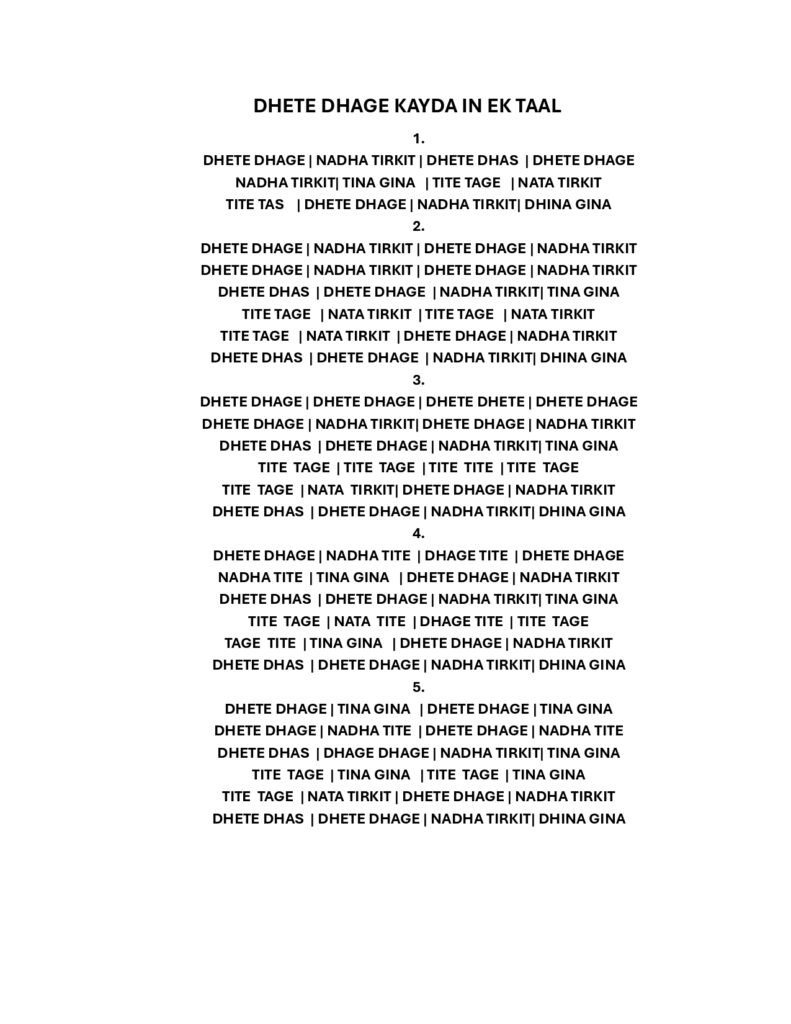
Ektaal Kayda No. 4
The fourth kayda in this series uses combinations such as:
Dhete Dhage | Nadha Tirkit | Tite Tage | Dhete Dhage
and develops these ideas through different rhythmic phrases.
A simplified presentation of the composition is:
DHETE DHAGE | NADHA TITE  | DHAGE TITE  | DHETE DHAGE
NADHA TITE  | TINA GINA   | DHETE DHAGE | NADHA TIRKIT
DHETE DHAS  | DHETE DHAGE | NADHA TIRKIT| TINA GINA
TITE TAGE   | NATA TITE   | DHAGE TITE  | TITE TAGE
TAGE TITE   | TINA GINA   | DHETE DHAGE | NADHA TIRKIT
DHETE DHAS  | DHETE DHAGE | NADHA TIRKIT| DHINA GINA
The exact presentation and phrasing can vary according to the gharana, teacher, notation system, and interpretation. Therefore, students should learn the composition directly from their guru whenever possible.
Why “Dhete Dhage” Is Important
The opening phrase “Dhete Dhage” immediately establishes the character of this kayda. These bols require controlled hand movement and clean articulation.
When practicing, do not rush the words simply because they are familiar. Each bol should sound distinct. A good tabla player should be able to hear the difference between every stroke.
Start slowly:
Dhete — Dhage
Then gradually connect the phrase:
Dhete Dhage | Dhete Dhage
Once the sound is clean, increase the tempo.
Understanding “Nadha Tirkit”
The phrase “Nadha Tirkit” introduces a more flowing movement into the composition. Tirkit is an especially important bol combination in tabla playing because it can help develop speed, coordination, and rhythmic continuity.
Practice it slowly at first:
Na-Dha | Tir-Kit
Focus on even spacing between the syllables. The objective is not simply to play fast but to maintain clarity, relaxation, and consistent tempo.
How to Practice Ektaal Kayda No. 4
A systematic practice routine can make this kayda much easier.
1. Learn the taal first
Clap, wave, and recite the 12-matra Ektaal cycle before playing the composition. Knowing where sam occurs is essential.
2. Recite before playing
Say the bols aloud:
Dhete Dhage, Nadha Tirkit…
Recitation helps your brain understand the rhythmic structure before your fingers have to execute it.
3. Practice at a slow tempo
Use a tabla lehra, tanpura, metronome, or electronic taal app. Begin at a comfortable speed where every bol is clearly audible.
4. Focus on sam
The sam is the most important point of the rhythmic cycle. Practice bringing the composition back to sam accurately. This develops your sense of laya and rhythmic confidence.
5. Increase speed gradually
Do not increase the tempo until your strokes remain clean. Speed should come from efficient technique rather than unnecessary hand tension.
Common Mistakes to Avoid
Students often make three mistakes while learning a kayda like this.
First, they lose the 12-matra cycle while concentrating on individual bols. Second, they play Tirkit too quickly, causing the strokes to become unclear. Third, they focus on speed before developing proper sound production.
Remember: clarity comes before speed.
A slow, accurate kayda is far more valuable than a fast performance filled with uneven strokes.
Why This Kayda Is Great for Tabla Students
Ektaal Kayda No. 4 combines several useful elements: Dhete, Dhage, Nadha, Tirkit, Tite, Tage, Tina, Ginat/Gina, and related phrases. This makes it a practical composition for developing both technical skill and rhythmic awareness.
It can also become a foundation for exploring paltas, variations, dugun, tigun, chaugun, and other forms of rhythmic development, depending on the teaching tradition.
Final Thoughts
Ektaal Kayda No. 4: Dhete Dhage Nadha Tirkit | 12 Beats is more than a sequence of tabla bols. It is an exercise in rhythm, coordination, discipline, expression, and musical timing. By practicing it patiently and keeping the 12-matra Ektaal cycle firmly in mind, tabla students can develop a stronger command of both technique and laya.
If you are learning this kayda, start with slow recitation, clean strokes, and a strong sam. Then gradually build your speed and explore the variations taught by your guru.
https://www.facebook.com/sbsinghtablaguru
https://www.linkedin.com/in/shree-singh-bb483059