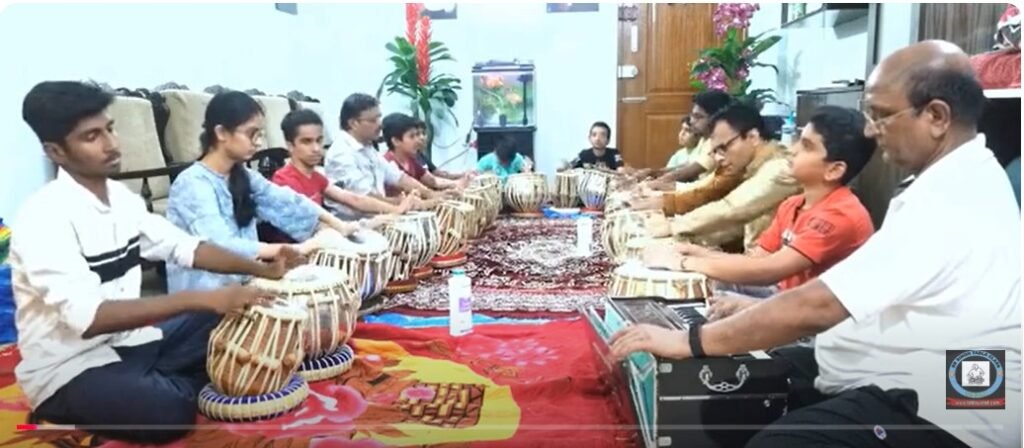
Mastering 14 Beats: The Ultimate Deepchandi Kayda
If you want to take your tabla playing beyond basic thekas, Deepchandi is the perfect taal to explore. Its 14-beat cycle has a distinctive, graceful character that can sound both deeply traditional and remarkably expressive. Mastering a Deepchandi kayda is not simply about memorizing bols—it is about developing control, balance, clarity, and an instinct for the rhythmic cycle.
Understanding Deepchandi Taal
Deepchandi, also known as Chanchar, is a 14-matra taal commonly associated with Hindustani classical, semi-classical, devotional, and light-classical music. Its traditional division is:
3 + 3 + 4 + 4
A commonly taught theka is:
Dha Dhin – | Dha Dha Tin – | Ta Tin – | Dha Dhin –
Different gharanas and musical contexts may use variations in the bols, so students should learn to recognize the underlying 14-beat framework rather than relying on a single fixed version.
The beauty of Deepchandi lies in its spaciousness. Unlike faster cycles, its 14 beats give a tabla player room to shape phrases, emphasize particular strokes, and create sophisticated variations.
What Is a Kayda?
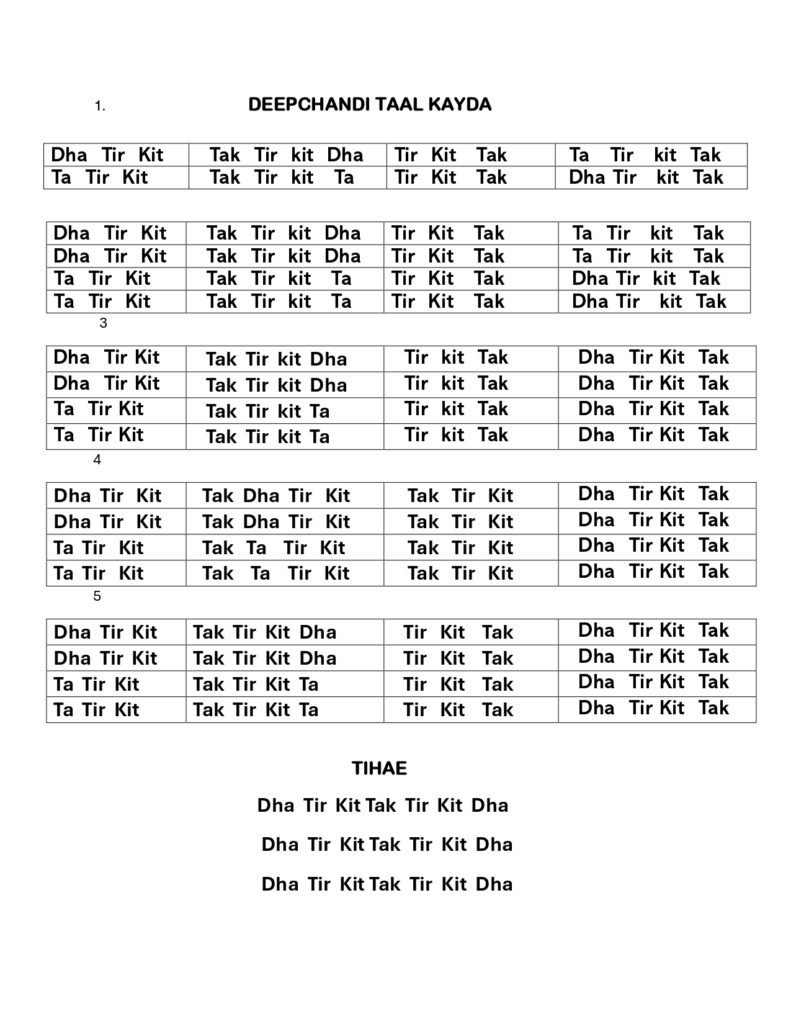
A kayda is a foundational tabla composition built around a specific set of bols. The main theme, or mukh, is developed through systematic variations called palta. Each variation must preserve the basic rhythmic and technical vocabulary of the original composition before returning to the mukh.
For a Deepchandi kayda, this process becomes especially interesting because the 14-matra cycle creates unusual possibilities for phrase construction.
A simple conceptual kayda might begin with a phrase such as:
Dha Tirakita Dha Dha | Tinakita Ta Tin | Dha Ge Na –
The exact composition can vary according to the teacher, gharana, and playing style. The goal is not merely speed. Every stroke should remain clean, balanced, and rhythmically accountable.
How to Practice the Deepchandi Kayda
Start by learning the theka without any variations. Count all 14 matras aloud until you can feel the cycle naturally.
Try counting:
1 2 3 | 4 5 6 | 7 8 9 10 | 11 12 13 14
Then practice the kayda slowly, ensuring that your phrase resolves correctly at sam, the first beat of the cycle.
Step 1: Slow Practice
Begin at a comfortable tempo. Focus on producing a clear distinction between strokes such as Dha, Dhin, Tin, Ta, and Na. If a phrase feels difficult, isolate it rather than repeatedly playing the entire composition incorrectly.
Step 2: Develop the Palta
Once the mukh is secure, create or learn variations while retaining its essential rhythmic and technical identity. For example, you might rearrange sections of a phrase, introduce tirakita, or alter the balance between bayan and dayan.
The important rule is: variation should grow from the original kayda rather than becoming an unrelated composition.
Step 3: Return to the Mukh
Every palta should eventually lead naturally back to the original theme. Practice identifying exactly where your phrase lands on sam. This develops the internal sense of laya that separates mechanical playing from confident tabla performance.
Common Mistakes to Avoid
One of the biggest mistakes students make is treating Deepchandi as simply “14 beats.” The taal is more than arithmetic. Its 3+3+4+4 structure gives it a particular musical identity.
Another common problem is rushing through the longer sections. Maintain an even pulse and allow the spaces between strokes to contribute to the groove.
Finally, don’t sacrifice clarity for speed. A slow, articulate kayda demonstrates much stronger technique than a fast composition filled with unclear bols.
Take Your Deepchandi to the Next Level
Once you can play the kayda confidently, experiment with different tempos and explore how the same phrase feels against vocal, instrumental, or semi-classical music. Listen carefully to accomplished tabla players and notice how they use dynamics, bayan modulation, pauses, and rhythmic tension.You can also record yourself. Listening back often reveals timing inconsistencies that aren’t obvious while playing.
Most importantly, remember that mastery comes from repetition with awareness. Practice each bol deliberately, feel all 14 matras internally, and make sam your rhythmic destination.
Deepchandi may have 14 beats, but its musical possibilities are practically limitless. Master its kayda, develop thoughtful paltas, and you will gain not only a new composition but a deeper understanding of rhythm, phrasing, and the expressive language of tabla.
https://www.facebook.com/sbsinghtablaguru
https://www.youtube.com/@BhagawanSingh