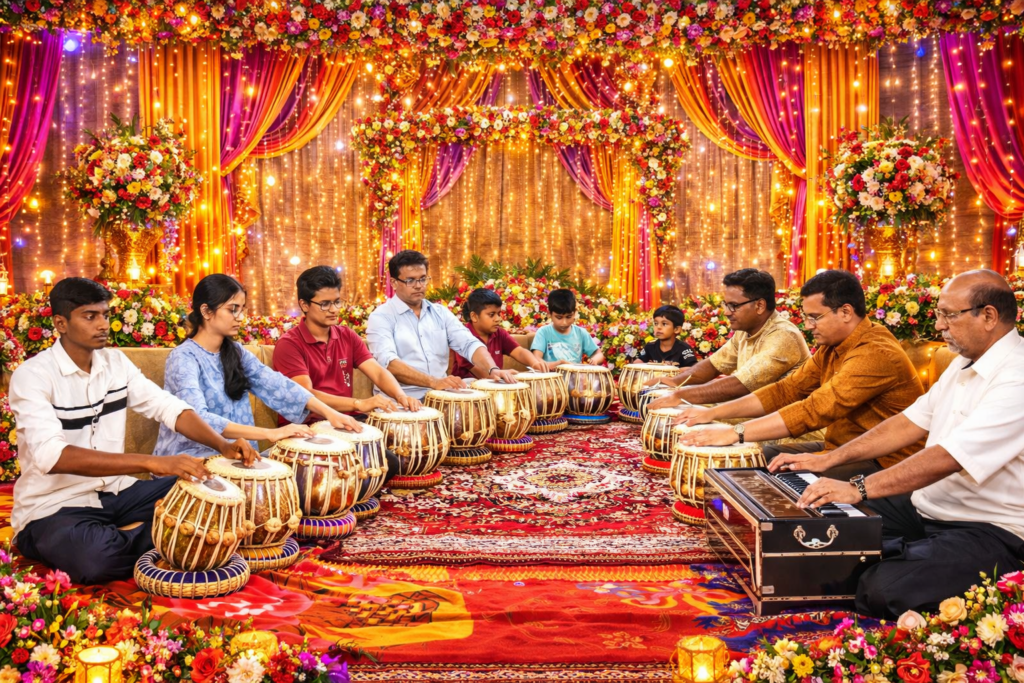
🥁 Jhap Taal Peshkar – 10 Beat Tabla Masterclass
Introduction: Unlocking the Power of 10 Beats
Did you know that some of the most captivating tabla solos in Hindustani classical music are built on just 10 beats? Jhap Taal (also spelled Jhaptaal) is one of the most expressive and intellectually engaging rhythmic cycles in Indian classical music. When explored through a Peshkar, it becomes a powerful gateway into creativity, expansion, and rhythmic mastery. In this masterclass-style guide, we’ll break down Jhap Taal Peshkar, understand its structure, explore its bols, and learn how to practice it effectively.
Understanding Jhap Taal (10 Beats)
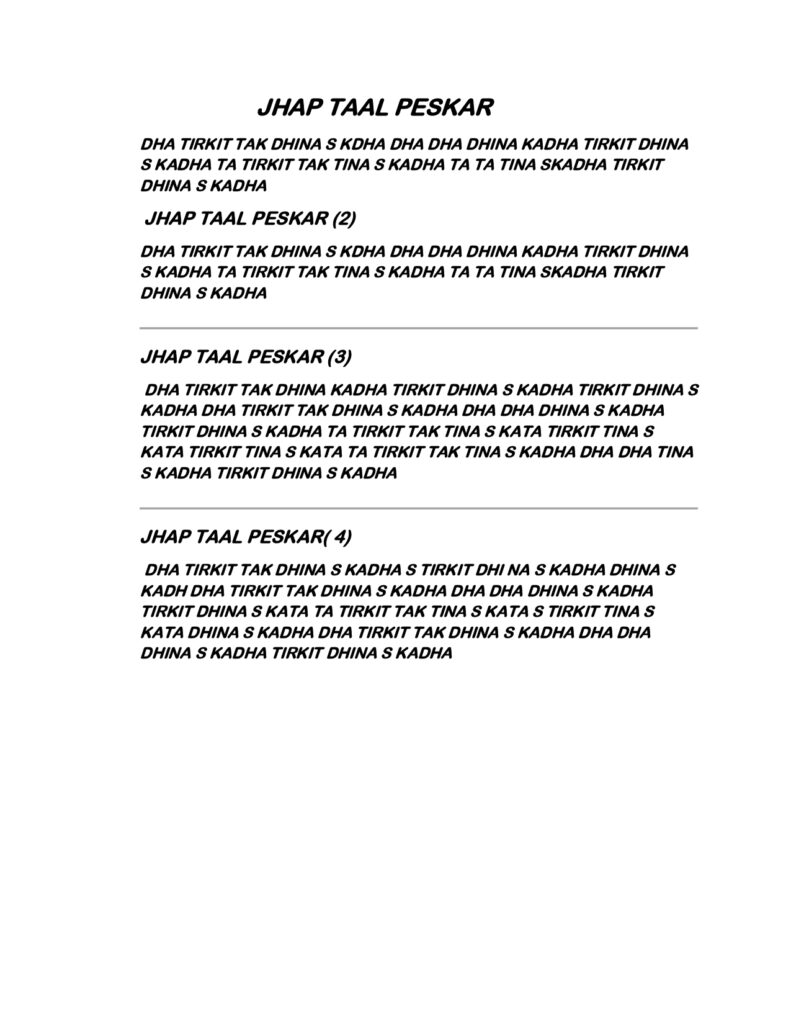
Jhap Taal is a 10-matra (beat) rhythmic cycle divided into 4 sections (vibhags) in the pattern:
2 + 3 + 2 + 3
Theka of Jhap Taal:
Dhi Na | Dhi Dhi Na | Tin Na | Dhi Dhi Na
1  2   | 3  4  5     | 6  7   | 8  9  10
Tali & Khali Structure:
- Sam (1) – Clap 👏
- 3rd beat – Clap 👏
- 6th beat (Khali) – Wave 👋
- 8th beat – Clap 👏
This asymmetrical structure gives Jhap Taal a unique flowing character compared to Teentaal (16 beats) or Ektaal (12 beats).
What is a Peshkar?
The word Peshkar comes from “pesh karna,” meaning to present. It is traditionally the opening composition in a tabla solo performance.
A Peshkar is:
- Slow and expansive
- Developed gradually
- Rich in variations
- Based on improvisation
- Focused on tone and clarity
In Jhap Taal, a Peshkar explores the 10-beat cycle through systematic expansion of bols.
Basic Jhap Taal Peshkar Structure
Here is a foundational Jhap Taal Peshkar:
Dha Dha Tete Dha Dha | Tete Dha Dha Tete Dha
Dha Dha Tete Dha Dha | Tete Dha Dha Dha Dha
This composition:
- Respects the 10-beat framework
- Balances symmetry within asymmetry
- Allows gradual development
Breaking It Down
Count carefully:
1 2 | 3 4 5 | 6 7 | 8 9 10
Now align bols with the matras and practice slowly in Vilambit laya (slow tempo).
How to Practice This Peshkar
1️⃣ Start with Theka First
Before attempting the Peshkar, play the theka steadily for 5–10 minutes.
Dhi Na | Dhi Dhi Na | Tin Na | Dhi Dhi Na
Use a metronome or lehra in Jhap Taal.
2️⃣ Play in Slow Tempo
Peshkar must breathe. Focus on:
- Clear “Dha”
- Open Bayan resonance
- Balanced “Tete”
- Even spacing
3️⃣ Develop Variations (Vistar)
Now expand creatively:
Variation 1:
Dha Tete Dha Dha | Tete Dha Dha Tete Dha
Variation 2:
Dha Dha Tete Tete Dha | Dha Tete Dha Dha Dha
Add subtle layakari (rhythmic variation) while keeping Sam strong.
4️⃣ Land Strong on Sam
In Jhap Taal, Sam must feel powerful and resolved.
Always practice returning cleanly to beat 1.
Tip: Pause after Sam to check alignment.
Common Challenges in Jhap Taal
🔹 Losing Count
Because of the 2+3+2+3 structure, beginners often drift.
Solution:
- Clap and recite bols
- Count aloud
- Practice with lehra
🔹 Weak Khali Awareness
The 6th beat (Khali) must feel lighter.
Practice isolating:
Tin Na
Keep Bayan minimal here.
🔹 Overplaying
Peshkar is not about speed. It’s about depth and tone.
Layakari Ideas (For Intermediate Players)
Once comfortable, experiment with:
- Dugun (double speed)
- Tigun (triple feel phrases)
- Bol expansion
- Syncopated accents
Example Dugun phrase:
DhaTete DhaTete DhaTete Dha
But always resolve cleanly to Sam in the 10-beat framework.
Why Jhap Taal Peshkar Improves Your Tabla Skills
Practicing this composition strengthens:
✅ Counting accuracy
✅ Tone production
✅ Bayan control
✅ Rhythmic awareness
✅ Improvisation skills
Many maestros like Ustad Zakir Hussain, Pandit Anindo Chatterjee, and Pandit Kumar Bose have demonstrated stunning Jhap Taal expansions in live performances.
Practice Routine (15-Minute Master Plan)
5 Minutes – Play theka steadily
5 Minutes – Play basic Peshkar slowly
3 Minutes – Try one variation
2 Minutes – Practice strong Sam landing
Repeat daily for 30 days to see dramatic improvement.
Mini Quiz 🧠
- How many matras are in Jhap Taal?
- What is the vibhag division?
- On which beat is Khali?
- What does “Peshkar” mean?
(Answers: 10, 2+3+2+3, 6th beat, To present)
Final Thoughts: Master the Asymmetry
Jhap Taal teaches you balance within asymmetry. Its 10-beat cycle challenges your mind while refining your touch.
A well-played Jhap Taal Peshkar is not just rhythm—it is architecture in sound.
Take your time. Play slowly. Feel every matra.
And most importantly—respect the Sam.
https://www.youtube.com/@BhagawanSingh
https://www.facebook.com/sbsinghtablaguru