Indication of the-Prarambhik Part-II Carnatic Vocal Music Course: Build a Strong Classical Foundation
Prarambhik Part-II Carnatic Vocal Music: Complete Junior Diploma Guide for Aspiring Vocalists
Carnatic music, one of the oldest and most sophisticated classical music traditions in the world, is built on discipline, devotion, and deep musical understanding. For students who have completed the basics and are ready to strengthen their foundation, Prarambhik Part-II Carnatic Vocal Music serves as a crucial milestone. This Junior Diploma level bridges the gap between beginner learning and structured classical training, shaping confident and well-grounded vocalists. This guide explores the scope, syllabus, benefits, and future possibilities of the Prarambhik Part-II Carnatic Vocal Music course, making it ideal for students, parents, and music institutions.
Understanding Prarambhik Part-II in Carnatic Vocal Music
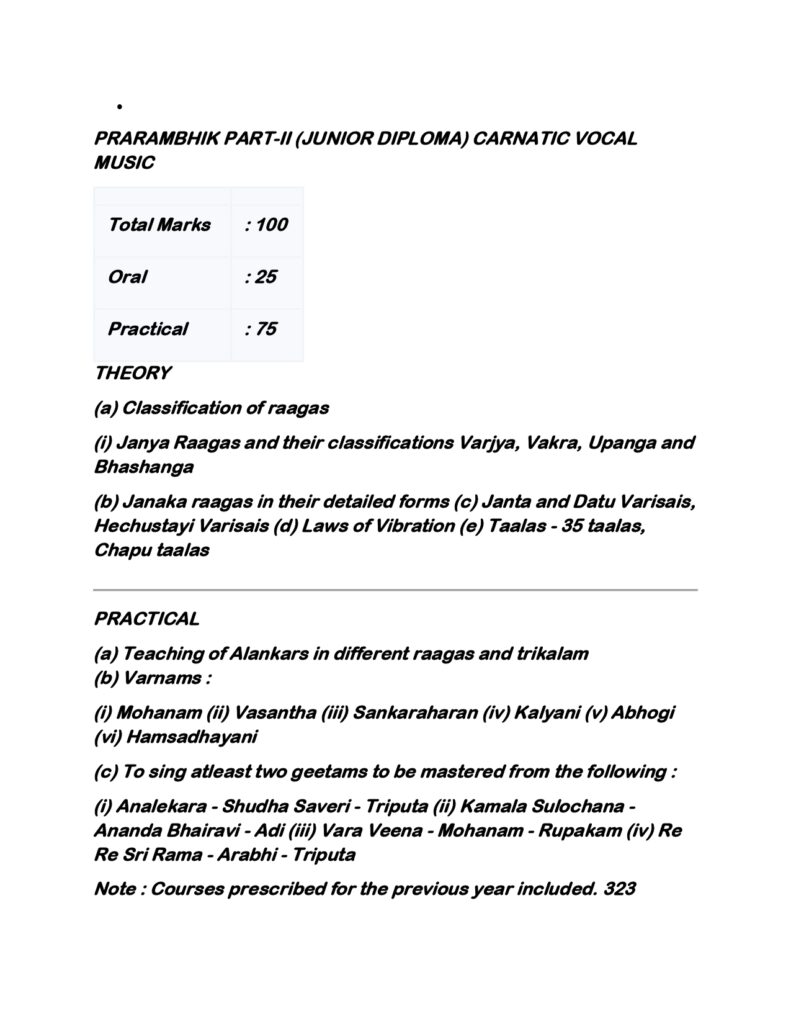
Prarambhik Part-II is the second level of foundational training in Carnatic vocal music, designed for learners who already possess basic knowledge of swaras, simple lessons, and rhythm. At this stage, students move beyond introductory exercises and begin understanding musical discipline, pitch control, rhythm accuracy, and melodic expression.This Junior Diploma level ensures systematic learning aligned with traditional Carnatic pedagogy while remaining accessible to young learners and beginners.
Course Objectives and Learning Outcomes
The primary aim of Prarambhik Part-II is to build musical stability and confidence. By the end of the course, students are expected to:
- Sing with improved shruti (pitch) and laya (rhythm) control
- Understand fundamental ragas and talas
- Perform simple compositions with clarity and expression
- Develop listening skills essential for advanced Carnatic training
- Prepare for higher diploma or certification levels
Prarambhik Part-II Carnatic Vocal Music Syllabus Overview
While the exact syllabus may vary slightly across institutions, most Prarambhik Part-II programs include the following components:
1. Advanced Sarali and Janta Varisai
Students refine voice modulation and speed control through more complex patterns.
2. Datu and Alankara Exercises
These exercises improve agility, breath control, and rhythmic awareness across multiple talas.
3. Introduction to Basic Ragas
Learners study ragas such as:
- Mayamalavagowla
- Shankarabharanam
- Kalyani
- Mohanam
Understanding raga structure helps students grasp melodic identity early.
4. Geethams
Simple compositions that introduce lyrical singing while reinforcing raga and tala concepts.
5. Basic Tala Knowledge
Students gain practical understanding of Adi, Rupaka, and other common talas through clapping and vocal practice.
Who Should Enroll in Prarambhik Part-II?
This course is ideal for:
- Students who have completed Prarambhik Part-I
- Children and beginners with basic Carnatic exposure
- Aspiring vocalists seeking structured classical training
- Learners preparing for graded music examinations
No advanced musical background is required—only dedication, practice, and interest.
Benefits of the Junior Diploma in Carnatic Vocal Music
Enrolling in Prarambhik Part-II offers multiple benefits:
- Strong Musical Foundation: Builds technical and theoretical clarity
- Traditional Learning Approach: Rooted in guru-shishya parampara principles
- Performance Readiness: Prepares students for small concerts and assessments
- Certification Advantage: Junior Diploma credentials add academic and cultural value
- Confidence Building: Encourages disciplined practice and musical expression
Importance of Carnatic Vocal Training at an Early Stage
Early structured training in Carnatic music enhances:
- Concentration and memory
- Voice culture and pronunciation
- Emotional expression and creativity
- Cultural awareness and discipline
Many renowned Carnatic vocalists began their journey at the Prarambhik level, emphasizing its long-term importance.
Career and Progression After Prarambhik Part-II
After completing Prarambhik Part-II, students can progress to:
- Madhyama (Intermediate) Diploma
- Advanced vocal performance training
- Temple music, bhajans, and light classical singing
- Teaching assistant roles with further certification
Though primarily a foundational course, it opens doors to both academic and performance-oriented paths in Indian classical music.
Final Thoughts
The Prarambhik Part-II Carnatic Vocal Music Junior Diploma is more than just a course—it is a stepping stone into the rich world of classical music. With structured lessons, traditional techniques, and gradual skill development, it empowers aspiring vocalists to move forward with confidence and clarity. Whether pursued as a passion, cultural education, or future profession, Prarambhik Part-II lays the groundwork for a lifelong musical journey.
1. The Philosophical Foundation
In Carnatic music, there is a famous saying: “Shruti Maata, Laya Pita” (Shruti is the mother, Laya is the father). This signifies that every piece of music is born from the union of pitch (melody) and rhythm.
- Shruti (Pitch): The relative musical pitch or the “tonic” (the base note, Sa).
- Laya (Rhythm): The temporal aspect or the steady pace of the music.
2. Core Technical Components
Swaras (The Notes)
The system is based on seven fundamental notes known as Sapta Swaras, which correspond to the Western solfège:
- Sa (Shadjam)
- Ri (Rishabham)
- Ga (Gandharam)
- Ma (Madhyamam)
- Pa (Panchamam)
- Da (Dhaivata)
- Ni (Nishadam)
While there are 7 basic names, these expand into 16 variations (Swarasthanas) that create the specific “flavor” of different ragas.
Raga (The Melody)
A Raga is a melodic framework. It is not just a scale but a set of rules for how notes should be played, including their order (ascending Arohana and descending Avarohana) and specific ornamentations (Gamakas).
- Janaka Ragas (Melakarta): 72 fundamental “parent” ragas that contain all seven notes.
- Janya Ragas: Thousands of “child” ragas derived by omitting or rearranging notes from a parent raga.
Tala (The Rhythm)
Tala is the cyclic rhythmic framework. Unlike a simple beat, a Tala has a specific structure of claps, finger counts, and waves.
- Adi Tala: The most common cycle, consisting of 8 beats.
- Suladi Sapta Talas: A system of 7 primary talas (Dhruva, Matya, Rupaka, Jhampa, Triputa, Ata, Eka) that expand into 35 variations based on their internal pulse (Jathi).
3. The Anatomy of a Composition (Kriti)
Most Carnatic songs follow a three-part structure:
- Pallavi: The first line/theme, often repeated as a refrain.
- Anupallavi: The second section, usually sung in a higher pitch.
- Charanam: The final and longest stanza that often incorporates themes from the previous sections.
4. Improvisation (Manodharma)
A concert is not just about singing pre-written songs. A musician spends significant time on creative improvisation:
- Alapana: A free-form, wordless exploration of a raga to establish its mood.
- Niraval: Improvising on a specific line of the lyrics while keeping the rhythm.
- Kalpanaswaram: Singing improvised sequences of swara syllables (Sa-Ri-Ga…) within the tala.
- Tani Avartanam: A solo section where the percussionists (Mridangam, Ghatam, etc.) showcase complex rhythmic patterns.
5. Historical Evolution & The Trinity
- Purandara Dasa (1484–1564): Known as the Pitamaha (Grandfather) of Carnatic music, he systematized the beginner lessons still used today (Sarali Varisai, etc.).
- The Trinity: In the 18th century, three legendary composers living in Tiruvarur—Tyagaraja, Muthuswami Dikshitar, and Syama Sastri—perfected the art form and composed thousands of kritis that remain the core of the modern repertoire.
6. The Concert Ensemble (Kutcheri)
A standard concert group includes:
- Vocalist / Lead Instrument: The primary performer (e.g., Singer, Flute, Veena).
- Violin: Provides melodic accompaniment and echoes the lead.
- Mridangam: The primary double-headed drum for rhythm.
- Tambura/Shruti Box: Provides the continuous drone (the “mother” pitch).
- Upa-pakkavadya: Secondary percussion like the Ghatam (clay pot), Kanjira (frame drum), or Morsing (jaw harp).