Introducing the-Deepchandi Taal Explained: Learn the Mesmerizing 14-Beat Tabla Groove with a Stunning Toda,
🎵 Deepchandi Taal Explained: Learn the Mesmerizing 14-Beat Tabla Groove with a Stunning Toda
If rhythm had a heartbeat, it would echo in the beats of the tabla. Among the many captivating taals of Indian classical music, Deepchandi Taal holds a special charm — a 14-beat rhythmic cycle that beautifully balances grace and complexity. Used widely in semi-classical forms like Thumri, Dadra, and Kajri, Deepchandi isn’t just a taal; it’s an emotional journey for both performer and listener.
Let’s dive deep into the magic of this soulful rhythm, its structure, and a stunning toda that showcases its mesmerizing flow.
🪘 1. What is Deepchandi Taal?
Deepchandi Taal (also known as Chanchar or Dadra in 14 beats) is a medium-tempo rhythmic cycle commonly used in semi-classical and devotional music. It belongs to the family of Vilambit (slow-tempo) taals and is often played in Kaharwa or Dadra compositions that emphasize lyrical beauty and expressive melody.
The taal’s 14 beats (matras) are divided into 4 vibhags (sections) as follows:
4 + 3 + 4 + 3 = 14 beats
Here’s the theka (basic rhythmic pattern) for Deepchandi Taal:
Dha Dhin Dhin Dha | Dha Tin Tin Ta | Ta Dhin Dhin Dha | Dha Tin Tin Ta
This cyclical structure creates a gentle but deeply emotional flow, allowing singers and instrumentalists to explore expressive nuances — making it a favorite for Thumri and Bhajan performances.
🎶 2. Historical Background of Deepchandi
The roots of Deepchandi trace back to the rich rhythmic traditions of North Indian classical music. Historically, it evolved alongside other taals like Jhaptaal (10 beats) and Ektaal (12 beats), offering musicians a slightly longer rhythmic canvas for improvisation.
Legendary tabla maestros such as Pandit Kishan Maharaj, Ustad Zakir Hussain, and Pandit Anindo Chatterjee have beautifully demonstrated Deepchandi in classical concerts. Over time, this taal transcended classical boundaries, finding its way into film music, ghazals, and fusion projects worldwide.
🧩 3. Understanding the Structure
Let’s break down the vibhags (sections) of Deepchandi:
| Vibhag | Beats | Bols (Syllables) | Clap/Wave |
|---|---|---|---|
| 1st | 4 | Dha Dhin Dhin Dha | Clap (1) |
| 2nd | 3 | Dha Tin Tin Ta | Clap (5) |
| 3rd | 4 | Ta Dhin Dhin Dha | Wave (8) |
| 4th | 3 | Dha Tin Tin Ta | Clap (12) |
The sam (first beat) and khali (empty beat) create the natural rise and fall in the rhythmic flow — a dance of sound and silence that gives Deepchandi its characteristic beauty.
🪄 4. Deepchandi Toda – A Stunning Composition
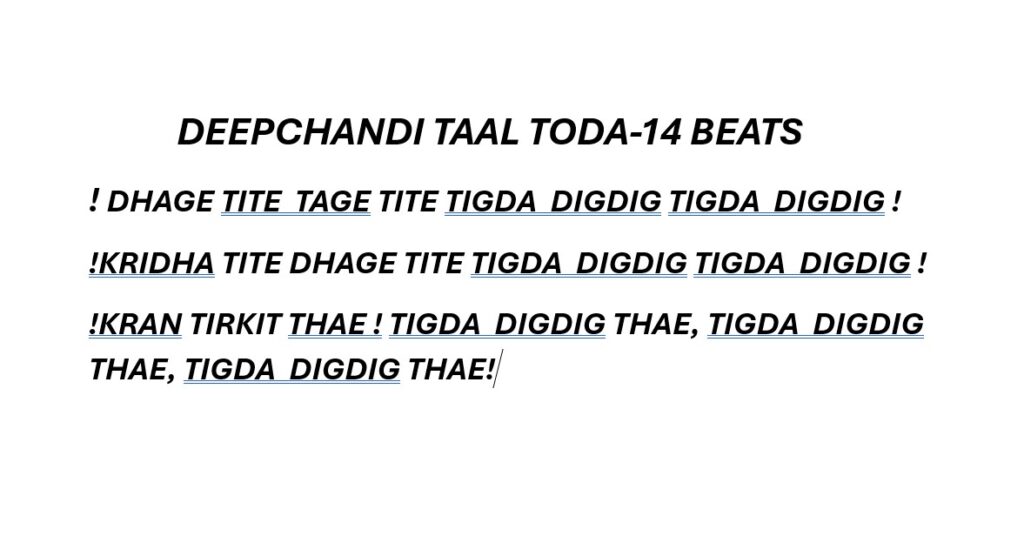
A toda is a short, rhythmic composition or flourish that tabla players perform to mark the end of a rhythmic cycle or to showcase skill. Here’s a traditional Deepchandi Toda example:
Dha – Trkt Dha – Trkt Dha Trkt Dha – Trkt |
Dha – Trkt Dha Trkt Dha – Trkt Dha – Trkt |
Dha – Trkt Dha Trkt Dha – Trkt Dha – Trkt Dha!
Played at moderate speed, this toda captures the lyrical and balanced nature of Deepchandi. Its repetition of Trkt (a rapid triplet phrase) gives it texture, while the final Dha on the sam (first beat) lands with authority and satisfaction.
🎧 Click here to listen to a Deepchandi Toda demo by Ustad Zakir Hussain
🎤 5. Deepchandi in Modern Music
Deepchandi has gracefully crossed the borders of classical music. You’ll often hear its rhythm in songs like:
- “Aaj Jaane Ki Zid Na Karo” – a timeless ghazal where the tabla softly caresses the melody in Deepchandi.
- “Mohe Panghat Pe Nandlal” (Mughal-e-Azam) – an example of Bollywood’s love affair with semi-classical taals.
- “Albela Sajan” (Bajirao Mastani) – where Deepchandi-inspired rhythms merge with orchestral brilliance.
Even modern fusion bands like Tabla Beat Science have used 14-beat cycles inspired by Deepchandi in their experimental compositions.
🌍 6. Why Learn Deepchandi Taal?
For tabla learners, mastering Deepchandi builds a foundation in layakari (rhythmic balance) and sensitivity. Its even spacing of claps and waves trains your ears to feel rhythm beyond numbers.
Learning Deepchandi also deepens your appreciation for Indian rhythmic aesthetics, where emotion and mathematics dance together. Whether you’re a vocalist, dancer, or instrumentalist, understanding this taal enhances your rhythmic intuition.
🧠 7. Quick Quiz: Test Your Deepchandi Knowledge!
Q1. How many beats are there in Deepchandi Taal?
Q2. Which musical forms commonly use this taal?
Q3. What is the pattern of vibhags in Deepchandi?
Q4. Name one Bollywood song that features Deepchandi rhythm.
(Answer key at the end of this post!)
🎯 Conclusion: The Pulse of Emotion
Deepchandi Taal is more than a 14-beat rhythm — it’s an emotional pulse that connects classical depth with modern expression. Its symmetry, grace, and timeless flow continue to inspire tabla players and music lovers around the world.
So next time you hear a soulful Thumri or a touching ghazal, listen closely — behind every heartfelt note, you just might hear the gentle heartbeat of Deepchandi.
Would you like me to make this into a WordPress-ready version (with image placements, SEO tags, and embedded YouTube samples)? I can format it perfectly for blogging platforms.